
Fear and loathing in Kenya

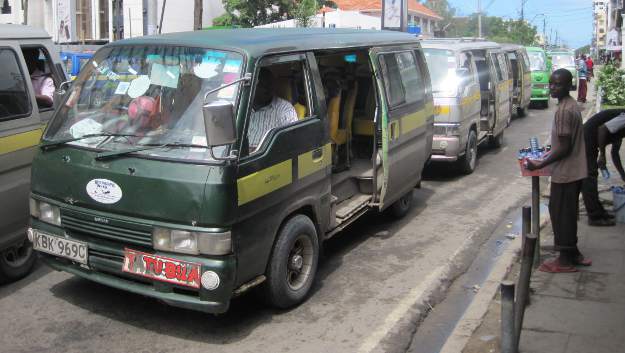
     A line of matatus waiting for passengers; the calm before the storm


     I hate matatus (vans that act as local buses) with a fiery passion. I hate everything about them. They alone can make me lose my enthusiasm for Africa. I hate the economic sense behind it where the drivers have to rent the vans daily and subsequently try with intense desperation to squeeze a profit, endangering everyone with their driving and stuffing passengers in without mercy. “Matatu” must be a Swahili word meaning “near death”.
     Since the system forces the drivers to act the way they do. I can nearly absolve them because in what other aspects of Kenyan society do I see people behave like idiots? Kenyans, in fact, often have a very quiet rapport with each other, I have noticed, if they have newly met. I know that it is all part of the African experience, to not let stuff like matatus get to you, to go with the flow, but I’ve been on a few buses in my life and my tolerance is shrinking.
     I have a simple solution to this. (I do! The Dromomaniac doesn’t just whine and moan, he provides solutions to the world’s problems!) The answer? Female matatu drivers. Paint the matatu pink, have a female driver and I guarantee every single woman in town would patronize it. The men would learn their lesson and drive sanely. Admit it: it’s another pure genius (FREE!) business idea from The Dromomaniac!
     Thank you.
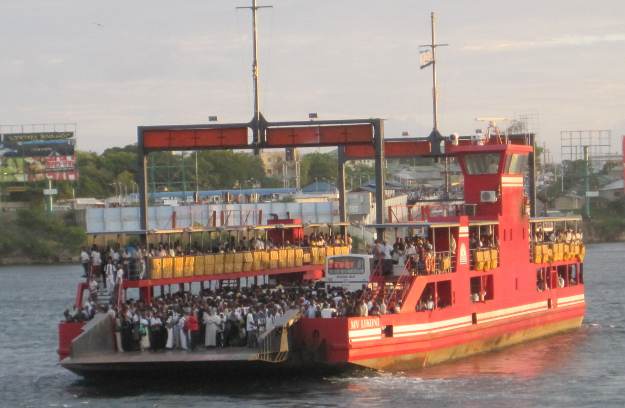
     The ferry port on the south side of Mombasa is a matatu hub, so I avoided it and easily hitchhiked the 35km south to Ukunda, the turn-off for Diani Beach, with a British-Indian guy. Unfortunately, I meant to go to Tiwi Beach, the turnoff 5km back. I hitchhiked there with a local guy, then hitchhiked straight to Twiga Lodge with another local guy who sold security systems, the mother of all growth industries in Kenya.
     Twiga Lodge was said to be a backpacker-friendly place, but 1500 shillings (US$18) is downright hostile to a backpacker. I walked a fair distance to investigate other options, but at dusk I had to come back with my tail between my legs and lose all my bargaining power. For 1500 shillings you can get 75 delicious fresh guava juices at Spicy Cafe in Mombasa’s Old Town! For 1500 shillings you can get 9 delicious mutton biryanis at Naushad’s Cold House in Mombasa’s Old Town! For 1500 shillings you can get seven and a half hair cuts at Yassin Hair cuts in Mombasa’s Old Town!
An outrage.
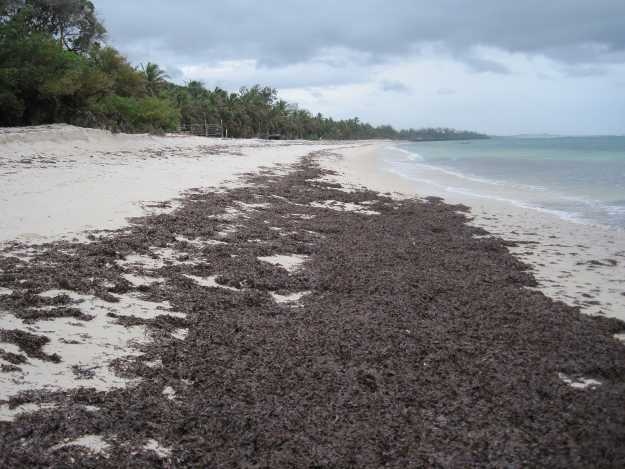
     Tiwi Beach is an excellent, secluded hideaway of a beach but with significant seaweed and more local beach boys hustling than there are tourists. I was blissfully ignorant of any lurking evil, but I was quickly set straight: the 4km due west between the main road and the beach is dangerous. The beach as it extends south is dangerous. Oh, but north, too, there are bandits if you head around the headland. So, only the actual ocean eastward is safe? No, you can’t walk out at low tide: sea urchins. Great. (I know what it’s like to step on sea urchins. I had an operation for this in Vietnam.)
     I had already walked the long way down to the tip of Tiwi, judging whether I could navigate the shallow river to Diani Beach when I met a local guy coming the other way. He said you can do it at low tide, but being alone here was most unwise. I would be mugged. I asked if it was really so, even in this calm place, and he showed me his arm where he had been slashed, saying that if people think you have a cell phone or 500 shillings (US$6), they will attack.
     Low season now is the worst time since there are few jobs, the economy is going to hell, people are frustrated, etc. I walked all the way back to Twiga Lodge with him. He told me he made 5000 shillings a month (US$60), paying 1500 shillings a month to rent a place with his wife and son, and then of course, the price of maize is going up, sugar, etc. He walked this path of many kilometers to work because there is no public transport to get here and he had no other option. A bicycle would be a significant improvement to his life, but he didn’t have money for it.
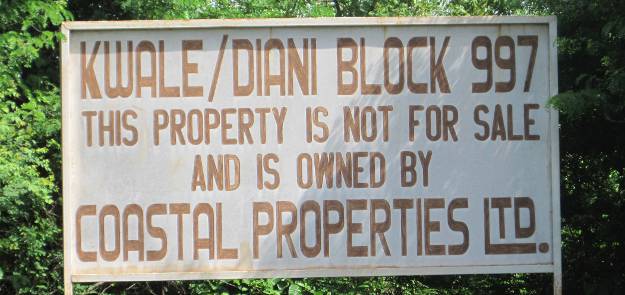
     I love this sign. In how many other countries do you see 'Not for sale' signs? They do this because some clever Kenyans manage to sell land that isn't theirs---and sell it 10 times!


     I don’t know how I came to this thought, but I’ve had it since Day One: Kenya is cutthroat. I don’t mean it in a bad way, but Kenya is the New York to Ethiopia’s Seattle, say. You need to be on your toes here, and fools will not be suffered gladly. Like New York, you take extra precautions, but it doesn’t mean you enjoy it less. For example, in Kenya I lock my backpack inside my hotel room, often locking it to a big object so someone would have to slash it to make off with something as opposed to taking the bag completely.
     In Nairobi it struck me that affluent people have their own taxi driver. They aren’t their personal drivers, but a normal taxi guy they can trust. (Is that like New York, too?) Same goes for motorcycle drivers, the guys who drive you to and from the main road to catch public transport. They all carry cell phones that they wedge into their helmets to talk hands-free, which always cracks me up for some reason.
     Nairobi is the major leagues of conmen and hustlers. Philip told me he was swindled by a money-changer once and was so surprised by the professionalism of it that he had the nerve to go back and tell him that he realized what had happened, but he was more impressed than annoyed and asked him to show how he did it—and the guy did! Now that I am thinking about it, that might not have occurred in Kenya.
     Kenyans need to be on their toes as much as travelers do. Cons big and small await the unsuspecting. Institutional corruption in Kenya is legendary. Not one day goes by in the newspapers without an expose, but it’s hardly news to Kenyans. The flip side of corruption is you have the liberating feeling that anything is possible if you slip someone a couple of bucks. If I ever want to fly cheaply out of Kenya to Europe, I would go to the Mombasa airport and bribe someone a couple of hundred bucks to put me on the Condor flight to Frankfurt or whatever the semi-charter airline is that goes to UK. This is kind of the Faustian bargain—if I am using the term correctly—that makes corruption hard to eliminate, because there can be benefits to it.
     When you first get to Africa it’s unsettling to see so many idle people and their relentless stares, and you become a little fearful for your personal safety. It doesn’t sound like something you get used to, but you do in the same way you do flies and Ethiopian beggars. In the end, nothing is unnerving. This is why I say travel makes you a stronger person: nothing phases you after a while.
     A Canadian guy once picked me up hitchhiking and then begged me not to hitchhike anymore, saying it was too dangerous. I smiled, waiting for him to see the irony. It reminded me of my first time in South Africa where I walked out of the airport in Johannesburg and hitchhiked to town. I didn’t think anything about it, but the mention of it to anybody caused a firestorm of opinion, and I became freaked out that I had cheated death.
     There are ways to hitchhike intelligently by doing some selective profiling. For one, you can stand near a speedbump to get a good look at the car and its occupants, and is someone driving a $20,000 car really going to mess with me? I can’t imagine it. Maybe the guy driving is only taking it to clean it for the boss, but it still seems like mugging me is too much of a risk.
     If something horrible happens to me tomorrow, would I have the same opinion?
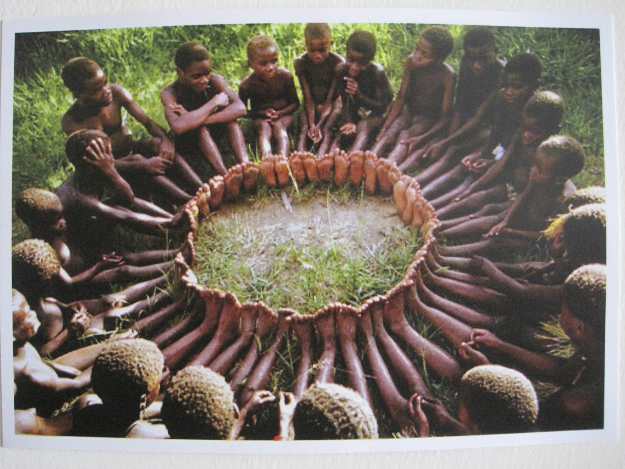
     Can we end on an uplifting note with this picture on Philip’s wall?
Deep lessons from The Road


     I sat next to this pretty girl on the bus from Lamu back to Mombasa. 19 years old, already engaged, ready to enroll at a computer school. We started with some small talk:

Me: “Osama bin Laden?”
Her: “I don’t know, but I heard he was a good man.”

…and then she was keen to listen to the music on my MP3 player. If she had been living in Lamu I bet she’d had very little exposure to western music (is that good grammar?), so what should I play? I started easy (“Dancing Queen” by ABBA) then zeroed in on something I knew she would like (“When Will I See You Again” by The Three Degrees) and then—I really shouldn’t have done this, but I thought the empowering female vocal might strike a chord and she’d want to brand pentagrams in each other’s foreheads (a little devil worship between new friends!)—Skunk Anansie’s “I Can Dream”. She was too polite to say anything and she hung in there for a good two minutes before I showed mercy and finished with “Peace Train” and “Moonshadow” by Cat Stevens, lifting one headphone to inform her, “This man is Muslim.”
     She looked skeptical. “What is his name?”
     “Yusuf Islam.”
     She still looked skeptical, but she let it pass, and she got off in Malindi.

     I've never seen palm trees like this anywhere else in the world, or maybe my eyes were closed at the time.


     My legs weren’t good after that bus ride. If I was finished with the coast I would have found the $50 one-way flights on airkenya.com to Wilson Airport in Nairobi to be very attractive. Cheap one-way flights always attract The Dromomaniac!

     That bus ride did provide an example of why traveling makes you stronger, helps you resolve conflicts and teaches you to stick up for yourself. On Lamu island, I was sold a ticket for a seat that didn’t exist. It just so happened that the configuration of this particular bus was different from the diagram where you pick your seat. It was probably an honest mistake, not something I am going to spazz out about. The local guy in Mokowe, a one-man bus station, he tried to get me to take a seat next to where the armed guard always sits. That seat next to the door, it is either the best seat or the worst seat depending on whether there is a barrier in front of my legs. I said I wanted to wait for the bus to arrive and see what it looked like, resisting his subtle pressure to simply accept it.
     I know the guy doesn’t care about my welfare, he just wants to solve his problem of where to move the mzungu and he will smile to my face and tell me any combination of lies to accomplish this.
     I know this and sometimes I still get bamboozled, but at least I have learned to stay polite and not appear upset or be threatening or do anything negative that will become counterproductive.
     So the bus comes and there is that barrier in front, meaning it has the least legroom, and we find another seat and it all works out in the end.
     OK, so the story wasn’t as powerful as you had hoped. Can I interest you in a photo of Vijay Optica’s promotional campaign? Yes!!!

     Two more practical things about Africa:
     If you are doing the classic overland trip, Cape Town to Cairo, like many, many people are doing, I’m surprised and pleased to announce, you should do it the other way around, Cairo to Cape Town, which almost no one is doing. The news doesn’t seem to get around: the problem is that Ethiopia does not give visas to overland travelers in southern Africa. You can get the visa on arrival if you fly in, but no one wants to do that and everyone goes to great, expensive extremes to get around this, namely sending their passport to a European embassy and back, costing hundreds of dollars, much more than a flight.
     Don’t sit in an internet cafe and write a long email to someone. Break it up into shorter emails, making them Part 1, Part 2, etc. Better is to keep saving it as a draft. In Africa you never know when the power goes out or the internet has a glitch, and then you have wasted half an hour on something you don’t want to replicate. Every traveler has a horror story about long emails that didn’t get sent. “Horror” is too strong a word, but not at the moment it happens.

     7am: couchsurfing on couch cushions on the floor at Philip's place.


     I left home exactly four months ago. I celebrated the event by almost buying dental floss. I guess it can wait a few more months. Who cares if my teeth look like David Bowie’s circa 1972?

Laying low in Lamu

     Everyone who comes to Lamu stays a long time. It’s by default that everyone gravitates to here. Where else can you go? Long-term travelers need a break, and Lamu fits the bill. It’s quiet, small, cheap to sleep, cheap to eat, there’s a beach, it’s probably safe—all these things that girls especially find appealing. One such girl, a sweet, statuesque, Rapunzel-haired Amazon from rural Ohio(!) who calls herself “Ash” (I need to start calling myself Wildfire or Stardust) is here semi-involuntarily because she has to go back to Uganda and there are riots there. I intend to go to Uganda, too, so it may foil my plans.
     Ash told me an incredible story. She was in a hostel in Uganda and a British backpacker was vomiting blood for some reason. They rushed him to the hospital and whatever it was, they needed to fly him home, but he had lost so much blood in the meantime that he apparently wasn’t going to survive without a transfusion, so four travelers from the hostel who had the same blood type donated, and they donated more than usual, causing all of them to stay in the hospital for a day and a half. The Brit’s life is saved, he is good enough to go home, and he leaves without even saying thank you or getting her email! “Ta!”
     An American guy here has overstayed his 3-month tourist visa by almost 3 years. He was unperturbed about what he would do when he decided to leave. I would be dreading my options. The corruption here is legendary and the penalty would be ugly if the Kenyans ever caught him, so what would you do in his situation? Sneak into Ethiopia and “lose” your passport? No, everything is supposedly computerized there as here. I don’t know what options you have. Somalia passports can be bought for $60 on the streets of Hargeisa, Somaliland. Maybe he could pass for a Somali (cough!) Good luck, bro. You probably have a book deal coming out of it.

     A graveyard doubling as a dump


     This is on the main street. I've passed by it dozens of times but I always expect to see two guys standing under it, one saying to the other, 'See, Klaus? I told you! Now pay up!' Who would expect to find such a museum in Lamu?


     Lamu is famous for its wood carvings on doors. I can appreciate the craftsmanship, but what catches my eye are the FIVE beefy locks on the doors. It's only a simple, small general goods shop. Why would someone need five locks if Lamu is so safe?


     I was at the Casuarina Hotel with its excellent location and 500 shilling (US$6) beds with sea views, but it’s otherwise hard on the body and mind and was slowly making me crazy. Plus, there was a major security breach: two mosquitoes managed to get inside my mosquito net one night, and I got some bites. I’m considering legal action.
     I changed to another place around the corner called Lamu Guest House. I lost my sea view but there is a huge bougainvillea out the back window that I know my mother would appreciate. The owner is an old fourth generation Indian (Gujarati) muslim who showed me all four levels, and then needed to lay down the rest of the day because of overexertion. I felt bad.
     I’m optimistic about getting some sleep, but it’s difficult anywhere. Beds are in rough condition. The sound of the muezzin, the call to prayer, is a loud one here, especially when it is next door. Hostel websites always seem to forget to mention adjacent mosques, but it’s hard to be away from a mosque. Braying donkeys are impossible to avoid, too. (Donkeys bray, right? They make that Eeyore sound?)
     I had two choices of pictures to show Lamu’s waterfront: the standard pretty shot or the half-submerged police boat with the Casuarina Hotel in the background. I couldn’t decide:


     Brad Pitt and Angelina Jolie have a place just across the channel from Lamu town, I’m told. Everyone wants to soak in this atmosphere, but the quaintness and cross-cultural shock of seeing oddities like a Maasai man in full tribal outfit working in a fifi boutique selling local crafts might be coming to an end. There are huge plans for this area. Despite the problems with Somali bandits, Lamu is going to be home to a new port and pipeline with new rail and road connections, all to bring Sudanese oil to world markets. It is going to change Everything with a capital “E”.

     Portrait of a formerly young man as an artist with United Airlines headphones after a very poor night's sleep

The end of the road: Lamu, Kenya

          The turtles and I would like to say that the mangoes are fantastic here on Lamu. I eat at least two a day. Depending on the size, they cost 10-20 shillings (12-25 US cents) each. I feed the donkeys the peels. It's a win-win all around.


     Below, the road to Lamu. It’s an all-day trip from Mombasa northward along the coast. By the afternoon the road worsens, traffic thins, and you see more monkeys than cars. There are checkpoints and road blocks because it has been under Somali bandit attack—as the bird flies, Somalia is less than 100km away—and all buses have an armed guard on them. The trees and shrubs grow into the road, making the neglect feel like you are coming to an end, and you are. The road empties into the Indian Ocean in Mokowe where a short boat finally takes you into the Lamu Archipelago. Lamu!

     Lamu is a predominantly Muslim town. It feels like I am back in Syria sometimes as I see lots of women in black robes, showing only their eyes. The first couple of times I heard the Arab greeting, I was roused:
     “‘Salaam aleikum’, you say? Oh, what’s this? You want to go Arabic with me now, do you? I was two months in the Middle East not that long ago, Habibi. Don’t make me dust off my Arabic! I’ll do it, you know! Hold me back! HOLD ME BACK!!”
     I’m already limbering up for wild arm gesticulations and clearing my throat for exaggerated gutteral sounds. Feeling good in Lamu!

     Every afternoon in the main square men sit around and play this carom game. It says something positive that in 2011 four grown men will play a simple game like this and eight men will watch, and when one team loses the next competitors race to occupy their seats like little kids. I also like that they have a bottle of baby powder close by that they shake over the board to facilitate sliding.


     Wait a minute, I'm getting mixed messages here from your flags. Are you a skull and crossbones hell-raising pirate or a peace-loving psychedelic hippie? Please explain.


     Even in remote Lamu, English soccer has a big following. I asked a man with a Chelsea shirt where I could watch a match and he laid out the three main places (that charge between 30 and 50 shillings—US 40-60 cents—depending on the demand for the match), warning me to reserve early if I wanted a seat. Reserve? Really? He assured me it was so and there are even seat numbers! In little Lamu! British soccer’s popularity wasn’t much different in Ethiopia. (Motherwell vs. Aberdeen at 8am, anybody?) It’s mind-blowing.

     The women who do this do it very quickly. It is something to watch. No, this is not my hand.


     I overheard the Osama bin Laden news on a radio at 6:30am in the home of someone next door to me. I never expected to hear Obama’s sober announcement coming from a Kenyan radio. I was surprised to later see news reports showing people celebrating in the streets in Washington as if something had concluded.
     There was no overt local reaction that I could see. I spoke to three people about it as all of them wanted to know if it was true. They didn’t trust the radio. One young woman—I think she was young; I could only see her eyes because she was fully covered otherwise—working in a restaurant asked me if the news was true. I said I believed so and she didn’t look happy about it. I asked, “Is it good news or bad news?”
     She said, “Bad news. He was Muslim.”
     I said, “But if he was Muslim that killed many people?”
     “He didn’t kill people,” she insisted, and then someone came to pay their bill, ending the conversation.

A Manchester United haircut in Old Town, Mombasa, Kenya


     This leg belongs to the woman who works at Barka restaurant in Old Town. She was wearing the full Muslim hijab, covered head to toe, but I could see she had a nice henna design on her hands and I asked if I could take a photo and she agreed, lifting her sleeves to show the rest of the pattern. Then, totally unprovoked, she hiked up her robe to her knees to show another design on her legs. I begged to have a photo of her face, but she said only if I took her to America.

     Mutton biryani for 280 shillings ($3.40) in the Barka restaurant. I also had the same deliciousosity in a hole-in-the-wall restaurant for 150 shillings ($1.90).


     I stopped to chat with Yassin of Yassin Hair Cuts in Mombasa’s Old Town district. He made a pitch to cut my hair. I asked if he had cut mzungu (white man) hair before, and he just laughed. The laugh could have meant yes or no, but I figured that even with a bad haircut, I’m not seeing any friends for a couple of months anyway, so what the heck?
     Yassin pointed to a large poster of the Manchester United soccer team on the wall and asked what haircut I wanted. I wasn’t prepared for this and everyone seemed to have the same style in the photo, so I just blurted out “Berbatov”, Dimitar Berbatov, the Bulgarian international striker. I must be the first and last person in any country to want Dimitar Berbatov’s hair style, as it’s not a good look.
     Whatever. I decided to let Yassin’s artistic vision run free, though in the end I could have said anybody as I was getting the same Edward Scissorhands cut. It was over in minutes, done entirely in shears save for the bangs where he dug out some scissors from the bottom of a drawer. He even went the extra mile and left the post-match Berbatov rake look on the front.


     Lonely Planet says something about Mombasa that you either “love it or loathe it”, but who in their right mind wouldn’t love Mombasa? I’m not sure I can be friends with such a person. I just don’t see it. Maybe I have tunnel vision and I am happy to occupy myself with anything until the next excellent meal, but I like walking the streets, too, seeing what there is to see, jabbering with anyone.
     The Old Town has great atmosphere but I don’t have any evocative photos of it. Its appeal doesn’t show when I think of snapping a photo of a dilapidated building or a ho-hum side street, rather it’s the fact that it’s a living, breathing neighborhood with a rich history, a colorful mix of people, and unbending towards tourists unlike Zanzibar’s Stone Town, I am hearing. (I am just making up reasons why I don’t have good photos.)
     Finally it’s warm. Nairobi is almost right on the equator, but it is at elevation and you would never know it. On the coast it’s hot and steamy. I don’t intend to wear long pants for a long while unless I am avoiding mosquitoes, which could be a good idea as I’m not taking malaria pills.

Profusely bleeding in my first hour in Mombasa, Kenya

     I had only to walk 100 meters away from the bus station in downtown Mombasa to feel the excitement of being here. It was warm and humid but with a nice evening breeze against my face, cooling me down from the all-day hotbox of a bus. It was heartening to see lots of people eating dinner outside at food stalls. Street food!
     There’s an interesting mix of people here: Indians, Arabs, Africans, plus there are old colonial British elements, it’s Muslim, decaying, tropical—my initial feeling is that it’s very Malaysian, reminiscent of all the things I like about Penang.
     I met Philip, my Couchsurfing host, and he took me to a restaurant to meet his other guests, an American couple who are relocating here from Rwanda. On the walk back to his place in the darkness I kicked the stub of a metal pole, thrashing my toe good. I could feel the blood seeping all over my sandal in seconds. Naturally, my first thought was a photo.

     At Philip’s I reenacted the scene in Psycho where the blood flows down the shower drain.

     The offending pipes, the guilty party, the culprit, and do I see a blood stain on said pipe?

     Talk about going from outhouse to penthouse, though I don't sleep in this room. I'm almost on the top floor of almost the tallest building in town with great views. I relish this after the wretched conditions of the New Kenya Lodge, a pervert's paradise with holes in every door. A hovel of a single room there was only 600 shillings ($7.50), but at what cost to my mental health?


     The top two signs are from Nairobi. The bribery one, they have the whole concept backwards: if you want anything done, you have to know how much of a bribe you need to pay. Right after I took the photo an unhappy security guard waved me over to him. I was hoping I was committing a horrible transgression that could be “resolved with cash pay”, like what happened to my Israeli friend, but he had me show the photo to him and wanted to know why I was taking it. I said, “Because this is Kenya. It’s funny,” and then left with the last word.
     I’m such a badass.

Hitchhiking in Kenya, escaping the hell of Easter

     I spent a lot of time in the Fisherman’s Camp reception shack on the campsite staring blankly out at the lake, hanging out with Beth and Moses who worked there. Beth, like many Kenyan women, I am discovering, speaks with a soft lilt in her voice that is very attractive. She could be reading technical manuals and I would be enthralled. I would pay extra to hear a Kenyan woman’s voice read audiobooks. (ANOTHER free business idea from The Dromomaniac!)

     This was midday when people started to pour in. The same vantage point photo when hardly anyone was there was two posts ago.


     When I arrived in Fisherman’s Camp there was hardly a car, just a few tents, but then the Easter crush came, and it was horrible. It was a zoo. Indians came in big groups, and I was amused that when checking in, they always demanded discounts. Some became agitated and there were raised voices, but it was just common banter. I initially mistook it for aggression because I thought their hackles were raised by Moses’ habit of calling every Indian who came into the office “Patel”.
     It was noisy and hard to sleep. All the camp rules were broken in one fell swoop, but the owner told me the next day that Easter and Xmas breaks were a “cathartic release” for everyone and I shouldn’t expect quiet. I moved to Top Camp with the splendid views over the lake, but it was even worse. Two groups of people spent the entire night threatening and swearing at and each other. One guy started his car and revved his engine like he was going to run people over, but then there would be laughter; none of it made sense. I knew I was powerless to do anything because they were so drunk and on fire, and no one who worked there cared.

     Since it was easy to hitchhike around the lake area, I decided to give hitchhhiking a go for the trip back to Nairobi, but I also wanted to avoid matatus if I could. A matatu is an old Japanese 14-seat passenger van that acts like a bus and is supposed to take only as many passengers as seats, but when they know there aren’t inspections, like late at night, they stuff as many people in as possible. Can I get used to the discomfort of 20 people crammed into a matatu? Would I ever want to if the feasible alternative is hitchhiking?
     I read that matatus are being phased out across the country, but it’s hard to imagine. There are now seatbelts for each seat, but I doubt anyone uses them even if it is universally acknowledged that they drive like maniacs. Before there was any effort to regulate the number of passengers, there would be newspaper headlines like, “2 matatus in head-on collision, 53 killed.”

     I easily hitched back to Nairobi. In fact, from the highway near Naivasha, I got a 100km ride straight to my hotel downtown, the New Kenya Lodge. The family that took me said they weren’t going out of their way to take me there, but it was hard to believe. I could tell they felt bad for me when they saw where I was staying. I mentioned I didn’t sleep well anywhere and the woman glanced up at the wreck of a hotel and pronounced with certainty, “You won’t be getting any sleep there.”
     Not many people know this, but “new kenya lodge” is a Swahili phrase meaning “ultra-sad, decrepit hotel.” Only after I checked in did I read in the Lonely Planet book that at night the worst part of town for crime is the corner of Latema and River Roads, exactly where New Kenya Lodge is situated. Lovely.

Searching for wild animals alone in Kenya (bad idea)

     When I first arrived in Fisherman’s Camp I met an Israeli who had walked some of the perimeter of Small Lake (also called Oloidien Bay or Lake depending on water levels) on the southwest corner of Lake Naivasha. He said he saw lots of animals, the same animals you pay $25 to see in nearby Hell’s Gate National Park. I listened carefully. It’s always wise to consult with Israelis on fiscal matters such as avoiding hefty national park fees, but the thing I would regret not taking note of was that he wasn’t walking around alone.
     I was hitchhking to that part of the lake when a safari leader picked me up. I told him my walking plan and he put me on edge with his insistence and exclamations:
     “Don’t get between a hippo and water!”
     “Don’t move if a hippo is charging you!” (Riiiiiight.)
     “Don’t scare the hippo! Sing or yell so it isn’t surprised!”

     I saw lots of flamingos on the western shore of Small Lake but I didn’t get very far on my walk before a security guard came to say I was about to tread on private land (which is supposedly a dubious argument if I stayed on the lake shore, but I didn’t make an Israeli fuss about it.) Defeated, I hitchhiked back towards Fisherman’s Camp. Hitchhiking is very easy with white people around here and merely easy with black people, Indians being somewhere in the middle.
     Three people in an SUV picked me up. I had to slide over a wide variety of empty bottles of alcohol to get in. The driver and his rheumy-eyed friend in the front seat had been doing plenty of drinking already, while the girl in the back seat looked fetching in a red cocktail dress. They had been partying, she explained, and the guys in front poured themselves drinks, asking if I wanted one. I was still fixated on the animals and not about whether drinking and driving in Kenya was tolerated, but when they pointed out to me small groups of impalas and zebras, and I got out of the car right away to watch.

     Zebra crossing (It's funny if you know British English, innit?)


     The shore of Small Lake. What lurks behind the facade?


     I was near the south shore of Small Lake and I found a path through an abandoned settlement to the lake. I walked in quietly through the forest to sneak up on zebras and gazelles in the clearing near the lake, but I went out with a racing heartbeat, squeezing an empty water bottle to make noise and fend off imaginary attacks from warthogs, buffaloes, and hippos.
     Along the lake shore I could tell it was a busy place for animals as I saw a wide variety of droppings. The biggest ones didn’t look like or taste like hippo droppings, so I couldn’t be sure if—oh, wait, I guess I shouldn’t admit that I, um—never mind. I saw lots of gazelles, an impala, a herd(?) or zebras, but my presence startled every animal to stop and study me, then scurry off hastily. A gazelle at full gallop was cool to see, but I felt I was interrupting the animals’ roaming, invading their turf. I remembered the wise words of mighty Caleb D. House: “On safari I had the inescapable feeling of an inverted zoo.” I didn’t like obstructing the animals, so I decided to leave, but the problem was that I had walked so far along the lake I didn’t know how to get back through the forest to the road.
     I made a beeline perpendicularly away from the water and behind some brush at a distance a warthog and I saw each other at the same time. It looked like a warthog. I stopped in my tracks and stared at it, wondering if it would charge me or be scared of me, but when it stood its ground, I retreated quickly. Suddenly I felt very alone and vulnerable. It was already late afternoon, when big animals might be coming out of their slumber to eat. I couldn’t see anything or anyone anywhere. I picked one path that had a lot of meter-high vegetation, but some rustling spooked me. On another path I freaked out when I saw plumes of dust stirred up, but couldn’t see what caused it.
     I remembered the safari guide’s advice in dealing with hippos, to sing and make noise so it isn’t surprised, so I got out my water bottle to squeeze it and sing “I’ve Just Seen a Face” by The Beatles. I don’t know why that came to mind. What am I supposed to sing? What is the appropriate hippo-avoidance song? Walking quickly in a semi-panic and singing in distress while trying to remember lyrics and running away from imaginary hippos is difficult, if you have no such experience.
     The end is boring: nothing dramatic happened. Worse, nothing dramatic happened on my 200th blog post on TheDromomaniac.com. How depressing.

The economics and safety of traveling with a tent and sleeping bag


     If I had arrived at Fisherman’s Camp self-sufficient with all my camping stuff, I would just have to pay a 500 shilling (US$1 = 80 shillings) camping fee. As it is, I am renting a tent (250), foam mattress (150) and blanket (100) for 500, so I’m paying 1000 total per day. I’m wasting 500 shillings a day, it can be argued, but when I think of traveling with a tent, sleeping bag and bedroll, the weight, the bulk, the pain of cramming your giant backpack into already-crammed buses and the intangible of being light, I don’t mind paying extra. I didn’t expect to camp as many days as I did, but it’s still a trade I make gladly.
     Same goes with big hiking boots. Don’t bring camping stuff or boots if traveling in warm weather places unless it is the main thing you are doing on your trip or you intend to camp often or you can store them at a friend’s to greatly minimize lugging the stuff around. I yap about this on the baggage section of my website. I gave away some clothes and mailed a kilo of papers and small souvenir junk home to get lighter. I found a place to store my giant stash of Somaliland money, and I can ride local buses with my bag on my lap if need be.
     A big question for me about camping is where to hide my valuables. Here, there are no lockers, no safeboxes, and the staff just parrot how safe the campsite is, that there are guards 24/7, blah blah blah, which is just nonsense they think you want to hear. The better gauge is the sign that says “YOU ARE HERE ENTIRELY AT YOUR OWN RISK.” I did the only thing I could think of doing: padlock the zippers of my backpack to my tent, so someone would have to slash both the tent and bag to get anything inside. Not much of a deterrent, but so far, so good.
     All of this said, I’m not much of a camper, much to my regret, and when I travel I am almost always on long, open-ended trips.
     Do you have different ideas/suggestions about this?

Related Posts Plugin for WordPress, Blogger...