Camel milk and Couchsurfing in Nairobi, Kenya


     Let me gush about my Couchsurfing hosts for a moment, though I gush about anyone kind enough to host me. (I’m not saying Couchsurfing is a young man’s game, but often when I search for hosts I use the Advanced Search option and filter out anyone under 30 years old. It eliminates the majority, but it saves rejection time and I get enough rejection from hitchhiking and supermodels.)
     I’m staying with three hosts here, (all under 30, so don’t listen to me), a team presently working on a project involving raising awareness about camels and specifically camel milk.
     There’s not one specific website they have, but some stuff is on whattookyousolong.org and videos here: youtube.com/user/wtysl
     I’m taken aback by how incredibly motivated, talented, sharp, dynamic, bright, open-minded and forward-thinking they are. Not many people have these qualities, if you think about it, and I can’t get over how young they are at the same time: Sebastian is 27, Alicia 26 and Philippa 23.
     Philippa’s laptop has the places written on it where she and the laptop have worked or where she has lived/traveled. You meet someone and hear their accomplishments, where they’ve lived and traveled and you assume they are 35 years old, but they are only 23! I’m pretty sure that when I was 23 I was still sucking my thumb and wetting the bed.

     I meet so many people doing big things in Africa, working with microfinance, water projects, conservation or some scholarly endeavor with some important NGO, and they ask me expectantly what I am doing. With my salt-and-pepper beard and diarrhea disguised as a laid-back demeanor, I must be involved with something big, but I can only disappoint them and say, “Um, I’m just traveling around."
     Alicia told me that she had traveled a lot and been hosted everywhere and this was her karmic chance to return the favor, but if there is anyone in this world who needs to host as payback, it’s me. For this reason I am thinking of buying a house—in North Dakota. Everyone is welcome!
     I didn’t want to overstay my welcome because, as the Italians say, fish and guests begin to smell after three days, but I stayed a whole week. I tried to be useful by transcribing interviews. a difficult task to do accurately and quickly at the same time especially with Rajasthani camel herders whose English is a challenge, shall we say.

     Do you know about camel milk? Camel milk is the miracle drink. Let’s see if the insta-expert can remember its benefits off the top of his head: high in protein, calcium, and immuno-globulins, low in fat, OK for the lactose-intolerant, free of all the hormones and nonsense in cow milk, a smoother, less-rich taste compared to cow milk,
     Camel milk cheese and chocolate are being made, but it’s all in its infancy since demand is low; the West doesnt know about it yet. (Can you imagine the stink and the disinformation campaign the U.S. dairy farmer lobby will make to defend its turf?)
     Camels don’t get foot and mouth disease, aren’t carriers of diseases, they eat vegetation other animals don’t, the milk is somehow beneficial for autistic people, and camel meat is lean and tasty, I can attest.

     Remember my Israeli friend, Orr? The day after we went to the synagogue, he was at the Yaya shopping center at around 9:30pm on his way to look for a place to watch a soccer game on TV when a plainclothes cop stopped him and asked for ID. No traveler wants to be walking around with a passport in Nairobi if he can help it, and he had none. I never walk around with ID since I am staying with a Couchsurfing host.
     You can imagine how it ended—with a bribe—but the middle was disturbing: they wouldn’t let Orr inspect their police ID beyond the guy holding it with his thumb over the name, they tried to put him in a private car, he was accused of being drunk and on drugs, he was handcuffed, he was eventually pushed into a car and dragged into a police station cell.
     Only with the aid of some local acquaintances who negotiated with the police (who had said, “This can be resolved with cash pay”) was he allowed to leave 10,000 shillings lighter ($125). They had started at 50,000 and then it was 20,000 for a long time, but it could easily have been much worse if he was stuck in the cell overnight or if things escalated to paying off judges, lawyers, etc.
     This isn’t necessarily a Kenyan story. It can happen anywhere, even in tourist-saturated places like Thailand where it’s easy to have a false sense of security, but it spooks me a little. One answer is to keep a photocopy of your passport, the two pages with your photo and visa, but if you are at the mercy of corrupt cops, it might not be enough. It might not be enough to have a passport if they are going to invent charges.
     Related to this, I’m not so keen to travel alone, though it appears I will as I almost always do. In six weeks I fly to Istanbul on Air Arabia for $276 one way (Thank you! Thank you! That’s very cheap, if you weren’t sure. It’s over nine hours of flight time and Kenya is not normally a cheap place to fly from. I’m telling you, all my cheap flight secrets are on my website if you have the patience to read it all. What was I talking about again?) My plan for Kenya and Uganda(?) is stay longer in a few places than to run around the country with my head chopped off. I’m hoping the coast is as interesting as I want it to be.

Blissed out on Lake Naivasha


     While changing matatus (buses) in little Naivasha town I was shocked to see a bunch of glue-sniffing kids strung out on the sidewalks by the bus station just like in the video I posted recently. I reckon I have seen a lot in life and am not phased by much, but glue-sniffing kids always scare me. I figure they are fearless as it’s as low as one can go; they are the true nihilists who may as well end it all since they are destroying their brains anyway.
     I asked a woman about it and she claimed they all had families; it was just what they did in the day.
     Anything on my mind vanished when I arrived in Fisherman’s Camp, an idyllic spot on the south side of Lake Naivasha about 100km northwest of Nairobi. People come here because it’s the opposite of Nairobi and there are a few popular national parks nearby. One, Hell’s Gate, can be considered Safari Lite as it is $25 to get in with a bicycle and ride among lots of animals, as opposed to over $100 a day for the major parks.
     I was impressed at first sight walking in from the road. It was so beautiful, so green. Southern Kenya is green. It’s the first expanse of green I’ve seen in over three months of traveling and it’s not even rainy season yet. The gently sloping grounds had only tall trees with perfect foliage, and a jetty with a desk to the end of it(?!)


     The campsite was full of birds and monkeys—two kinds of monkeys, vervets and the skunk-like colobus—and I could hear the nearby hippos’ snorts and grunts, the loud screech of a large ibis, and most plentiful were a colorful, seemingly luminescent blue and orange-breasted bird supposedly called a superb starling.
     At night I could watch a few hippos closely from behind a tree (and from behind an electric fence, I must add, because after malarial mosquitoes, I read that hippos kill the most people. Matatu drivers must be number three.) I watched them graze while avoiding monkey droppings from above.

     I read that “Tomb Raider” and “Out of Africa” were filmed nearby. I do nothing much more than hang around and gaze out on to the lake; it’s very relaxing here.


Kenyan Egg Economics
     This man above was at this shop to sell his eggs for 8 shillings each. The shop sells the eggs for 10 shillings each. He said it costs him 6 shillings an egg to produce. (I love having open, honest conversations like this because where in the so-called developed world can you ask someone, “What is your wholesale price and how much profit do you make?” and if the shop owner knew his cost was 6, would she squeeze him to sell for 7?)
     He says he produces 500 of these 30-egg trays a week and sells all of his production in two days, so he makes a profit of 60 shillings per tray, multiplied by 500 trays is 30,000 shillings profit a week, which is about $375. I remarked that it was very good money, and he agreed, pointing to his flashy new truck outside. It wasn’t even his main job. He was an engineer.
     How he could sell so many eggs? Because people are poor. He held up four eggs. “This costs 40 shillings for a family to get protein. A half kilo of meat is 150 shillings.” Case closed.
     When I told all this to the girl at the reception at the camp, the only thing she said was, “Is he married?”

Seder in the Nairobi synagogue

     Met an Israeli traveler named Orr and due to an unpredictable chain of events, I found myself taking part in a seder in the Nairobi synagogue during this holy Jewish time of Passover. Who knew there was a Nairobi synagogue?
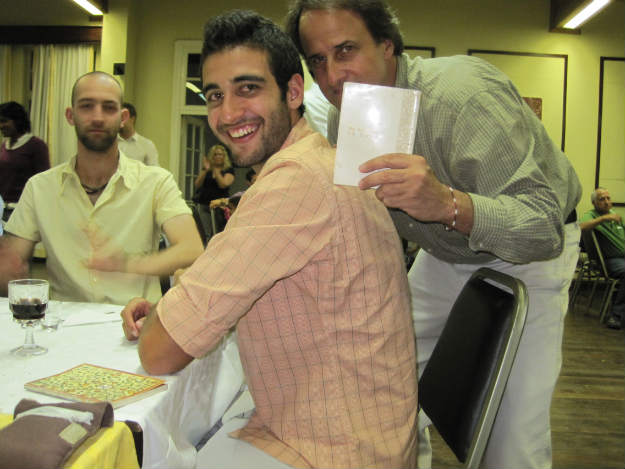
     What I know about Jewish traditions can fit comfortably on a pinhead, so it was all new to me. The other guy in the picture, Orr described him as a “professional Israeli”, since he knew precisely when to arrive for the food, missing out on all the sacred traditional stuff. Wise man.
[/caption]

     Are you aware of the disturbing new trend in passport stamps? (Did you not read the last issue of Passport Stamp Quarterly?) Everyone wants to put a giant sticker in your passport, taking up the whole page. Is there a reason Kenya can't just make a little stamp instead of devouring a whole page of my passport? This is in the new era of no free extra passport pages, so a big sticker puts you that much closer to a new passport. It's costing you. The Kenyan government is taking money out of your pocket. Are we travelers going to take this sitting down? Rise up! Revolution!


     The other thing about this photo is to show the bump on my finger that I had operated on in Japan last year (story and gory pix here!) The bump never completely went away and my finger is still swollen more than I like, but as they say in Singapore, “What to do?”

(Based on my first three hours) I hate Kenya

     My last day in Somaliland I was hitchhiking in Hargeisa and a Kenyan man picked me up. He claimed—and I have to quote him—“Nairobi is like London.” I’d never been to Kenya, so who was I to refute that?

     The saddest wheelchair ever. Berbera Airport, Somaliland


     I paid my $33 airport tax (tell me again: Somaliland wants tourists?) and embarked on my Jubba Airways flight, their slogan being, “The Happy Way to Fly.” Who are they fooling? They take some tired, decrepit Russian (Soviet?) 737 with Allah knows how many hours of flights on it, slap their name on the side, and this is the happy way to fly?
     That said, I enjoy it when they announce, “We wish you a pleasant flight, inshallah (God willing).”

     An aerial view of Berbera Airport, it of the aforementioned super-long runway. How long is the runway? The runway is soooooo long that from the terminal I saw our plane (coming from Dubai) land towards me, and by the time it came to a stop, it was still far away.


     A funky view high above Djibouti


Aerial shot of Mogadishu, Somalia


     I woke up at 3am to catch the bus to catch the plane, so I was tired, but how can you sleep when you’re about to land in Mogadishu?
     There was no Baghdad-style corkscrew landing. Maybe safety is improving. In fact, the airport looked downright inviting. It’s right on the beach, parallel to it, and not some phony San Francisco or Osaka landfill airport, but small waves lapping against the rocks right next to the runway.
     Mogadishu airport looks a hundred times better than JFK.

Mogadishu airport with a couple of the flight crew


     I thought of jumping down on the tarmac so I can have a few hours’ argument with my friend Graydon about whether this constitutes a visit to Somalia, but instead I took photos of the flight attendant’s hands. She has this henna design because she attended a Somali wedding.

     A police dog sniffing my green and black backpack. The stench of my dirty clothes made him consider early retirement.


     We made a previously unannounced stop in the northeast Kenyan desert town of Wajir to go through customs and immigration. Someone mumbled that this was an extra security layer because we were coming from Mogadishu.
     I had to step over the puke in the aisles to go stand in the tarmac heat so too-few Kenyan immigration people can process a plane-load of passengers. It wasn’t my idea of a good time, it was so poorly organized, but I was wistful for it by the time we got to Nairobi.
     I didn’t need to show my fake onward ticket, but I was prepared. I had my “reservation” on Condor Airlines from Mombasa, Kenya to Frankfurt, Germany. If you are new to my website, I explain why this is a good idea about a third of the way down the page.
     As we descended for the last time into Nairobi a flight attendant sighed heavily into the microphone and with impressive candor wearily said, “This is the end of a long flight day. We thank you…” Amen, sister.

Calm before the storm at Nairobi airport


     For some inexplicable reason that was never announced, the system to get out of the airport starts with everyone on the plane looking for the guy with the list of everyone on the flight so he can give you a number that you go to another guy to say your number and then you can go through the metal detector for you and your bags, but the X-ray machine for the bags sends you in a different direction than the walk-through metal detector, which caused another bottleneck of angry people.
     Then guys didn’t have the right lists, and most maddeningly, because you are supposed to be flexible in Africa, no one could explain anything; they just had vacant looks in their eyes and couldn’t speak, ignoring everyone. It exemplified the worst African stereotype that I had forgotten because in Ethiopia you can talk to everyone and have intelligent conversations. At the Nairobi airport they all just stood like wooden Indians that everyone fumed at.
     Somehow I managed to get myself through, but then there was no signage to tell us where to go. It was one little thing after the other like that, and then the bags didn’t show up for nearly two hours after we had landed despite there being no other planes that had emptied itself of baggage during that time. Someone told me that Kenyan airports are trying to suppress other countries’ airline operations to boost up their own carriers, but whatever the reason, it couldn’t have been a worse introduction to Kenya.
     While I sat and waited for my bag I discovered the airport had wifi. Free, fast wifi is usually the ultimate salve, but I was still on fire after getting into the terminal. I was waiting in line in a shop to make a phone call when a guy approached to shake my hand. “I am Patrick; you don’t remember me?"—an old confidence trick that I was in zero mood for. He was a huge man but I aggressively pointed in his face, “Not now! Don’t even try that with me!"

     An Arab woman stood next to a Kenyan girl and they offered to help me, but the Kenyan girl asked me three times if I was alone, and three times I answered until I exploded at her, too: “How many times are you going to ask me?! What’s wrong with you?!”
     She quietly said, “I was just trying to help.”
     “How is my telling you three times that I am alone helping me?!”
     The Arab woman said she had to take a taxi to town and we could share. I said I was going to take a bus to town, but I wasn’t sure I meant it as darkness was approaching and Nairobi, like Johannesburg, has a solid reputation of being dangerous that will take generations to shake. She tried to talk me out of it. She said that it wasn’t safe. “I’m Kenyan and we’re scared in our own country.”
     I realized I was acting like an idiot, and I could see that she had my interests at heart and she was right. I got in the taxi with her and she reached across to make sure my door was locked.

     Of course I trusted Hamida implicitly because of her henna tattoos. I like the look. Why hasn’t this caught on in America or Europe?
     Maybe I know why. Hamida was scratching her hands the whole time as the henna irritates her skin, but she said she did it because her husband likes it.
     I asked, “Does your husband do something for you?”
     She made a face and threw her hands out in front of her, meaning no.

     Our taxi driver was reading a book called, “Smart Women Finish Rich”. I asked why.
     “Because I want to be rich.”
     “But you’re not a woman,” I reminded him.
     He looked at me in the rear-view mirror and said, “They are smarter than us.”
     The taxi dropped me off first. I tried to pay my half but she took only a fraction. I insisted, but she wouldn’t hear of it, so I went with another tactic. I argued, “Your husband will be angry at you for throwing away money like that!"
     She parried, "He doesn’t know how much money I have!"

     While I am piling on Kenya (don’t worry, it is just a temporary thing; I’m slowly becoming jazzed to be here), before I came, the image of Kenya that was etched in my mind was from this seven-minute documentary on CurrentTV, my favorite TV channel, particularly the disturbing segment starting at 3:01. There’s nothing uplifting about this film, but it is well done. Have a look.

A Syrian joke

     President Assad’s daughter goes into a fancy store in Beverly Hills and the staff look at her and say, “You can’t shop here; you have no money.”
     Assad’s daughter says, “I have money! I can shop here!”
     They ask, “What is your job?”
     She says, “I don’t have a job.”
     They ask, “What is your father’s job?”
     She says, “My father owns 21 million (the population of Syria) cows”.
     They say, “We don’t believe you. How can your father feed 21 million cows?"
     She says, “He doesn’t feed them. He just takes their milk.”

Somaliland is like Las Vegas

     At the moment we arrived back in Hargeisa from our weekend in Berbera, the first rains of the season came, and though the downpour lasted no more than 30 minutes, the streets were instantly flooded. When the rain subsided, people came out to stare at the water like it had snowed.

     Chris from Liverpool (Gerrard's a tosser!) sampling some goat and rice in the Somaliland Restaurant which is about two blocks behind the Oriental Hotel. It's a total dive where there are no menus but lots of grunting waiters. I think we ordered 'meat and rice', so I was blown away when this came. The goat had to have been cooked forever as it was so tender and tasty and the rice was infused with cinnamon and other spices (17,000 shillings, about $3.00)


     I’m at the Union Star Hotel, two blocks west of the landmark Oriental Hotel. $4 for a single. It’s OK. I mean, your mother would burst into tears if she saw where you were sleeping, but if you are used to Africa, there’s not much to complain about for $4.
     I thought of staying in the spiffy Oriental at $15 a night to get some much-needed rest, but that was before the manager accused me of “scamming” the hotel because I was using their wifi. I pointed out that I had bought a drink in the restaurant, but he was unmoved and now he is my mortal enemy.
     The manager at my hotel is hardly better. He tries to divide and conquer by overcharging us individually with creative math and berates us to pay before we question him. The next day he does it again, as if we are idiots.
     This is when I wish I had a hidden camera so Somalilanders can see how it is for foreigners. They drink their own Kool-aid a little too much about how nice everyone is here and how they would never try to rip off a foreigner, but no Somalilander knows the traveler experience.
     It is correct that the people here are fantastic and it has been refreshing to have many conversations with Somalilanders who are eager to discuss things and satisfy their curiosity about visitors. They don’t treat you like a zoo animal, either, but are genuinely interested in you and what you are doing and think of their country. (My favorite was a guy in the back of a moving truck who said as he passed, “Please tell me your opinion of the security situation in Somaliland.” What could I say? I moved my elbows in a circular motion and yelled as he drifted away, “I feel pretty good here!”)
     It is incredibly easy to hitchhike within town here, too, an unmistakable sign of a friendly place. I just walk along the main drag and point ahead, saying, “You go straight?” and someone almost always stops.
     But, as much as that is the norm, for a complete picture I have to add travelers have to deal with hotel manager bastards, larcenous taxi drivers, and guys like yesterday who will come up and yell at Chris and me for taking a photo of a telephone pole (because of the hundreds of wires emanating from it) ranting that we need a permit from the government.
     It is like anywhere, a few bad apples mixed in with the good. Somaliland is not quite yet Shangri-la.

     I collect small denomination banknotes. This mountain of money in its entirety is worth $19. I ran around to every bank until I found a sympathetic guy who would trade me whole bundles of 5, 10, and 20 shilling notes, all out of common circulation (for good reason!) I just wish it wasn't so heavy. I don't know how I am going to get it home. I don't know how I am going to fit it into my backpack. I don't know if this was a good idea.


     Bought a ticket today. Tomorrow I fly from Berbera to Nairobi, Kenya for $220 one way, which includes a free bus from Hargeisa to Berbera. It’s on Jubba Airways, a regional airline based in…drumroll…Mogadishu! Yes, I fly via Djibouti and war-ravaged Mogadishu, Somalia. I hear Mogadishu is lovely in spring. I don’t think I have to get off the aircraft during the stopover, thankfully. I asked the guy at the ticket office if it was safe to fly through Mogadishu, and he just shrugged his shoulders.
     How is Somaliland like Las Vegas? I’m very glad I came to Somaliland, it’s a completely worthwhile experience, a fascinating place, but I can’t wait to go. It is so oppressively hot, busy and dusty here, I’m exhausted and feel like I am going to be sick again. Maybe if I could sleep I would be more at peace here, but I hear the Kenyan coast calling me, screaming for me. I hope no Somali pirates are screaming for me in Mogadishu. Are there land-based pirates?

     Homemade Somaliland license plate. Nice!!

Berbera, Somaliland—Let’s go swimming!

     I went to police headquarters to get my magic letter allowing me to travel back to Berbera without a guard and when I had it in my hand, I asked about Gabor, the Hungarian who was plucked by the police when he tried traveling without one. The Big Cheese said that Gabor was given a letter yesterday so he could go to Djibouti, but when I asked about what had happened the last three days and whether he was arrested, he said that he wasn’t arrested but smiled, “Don’t worry, don’t worry!” It didn’t reassure me, but I didn’t press him further.

     It is hard to get a good photo of this caravan. I've never seen so many camels in my life as here in Somaliland, a big plus in my book. Who doesn't love camels? Who? WHO? I want names!


     For the trip to Berbera, Katie and I met up with the guys who got turned back at the checkpoint before, French Nicolas and two Asians, a Japanese named Takenori and a Korean named Ryu. Local people see Asians and start yelling, “Jackie Chan! Ni hao!” but they take it in stride, much better than I would.
     Ryu said he learned his perfect Japanese just by his appreciation of anime, which tipped me off that he could only be a North Korean spy, but I told him his secret was safe with me.

     We stayed at the Yaxye Hotel in Berbera, $7 single, $8 double and free wifi(!) to go with the rock-hard beds. There's ALWAYS something that prevents me from sleeping well.


     This man has his khat and is ready for the afternoon!


     Berbera was hot, much hotter than Hargeisa, maybe 40C (105F) hot. We all had ideas of staying longer on the coast, but the brutal heat quickly changed our minds.
     The real torture of the heat is to have to wear long pants. It’s a muslim country and though foreigners’ ways are given a lot of slack, it isn’t really appropriate to wear shorts. But listen to this: it is OK to wear shorts if you are playing sports or on your way to playing sports, so what if I walked around with a tennis racket all day? Genius or what? And I blog for free!
     Somaliland is a conservative Muslim country, which may seem redundant to say, but it doesn’t mean the people aren’t friendly and curious. Once a girl walked by in full veil, just her eyes showing, and greeted me in a sing-song loopy voice, “Hellllloooooo!” That doesn’t happen anywhere else.

     Grilled fish in a sauce with potatoes. 20,000 shillings, about $3.75.


     The quintessential Somaliland photo: the restaurant bill and the stack of bills needed to pay for it.


     We went for a walk around the quiet, dusty streets of Berbera. It seemed that everyone—and I mean everyone—wanted to stop us and say hello, chat, ask what country we’re from, etc. Most were very receptive to photos, too, which was a boon for Nicolas as he is taking hundreds a day. He’s a TV cameraman in Paris who’s probably not used to asking for permission, and he gets us in trouble all the time with people howling when he points his giant lens at them. The worst was on the highway when we stopped to stretch our legs. He had been taking photos and a woman came charging to the road with a big rock in her hand, very upset, until our guard had pacified her somehow. It was the only time I was happy to have a guard.


     The town is of interest, but the beach is what we were here for. We were so focused on it that we collectively lost our minds and left at the hotel our towels, sarongs, sunblock—everything useful. We were woefully unprepared, plus we walked several kilometers in the midday sun. We all knew we were going to get fried as there was no shelter anywhere, but we had such tunnel vision to be in the sea, we damned the consequences. It’s not every day one gets to swim in the Gulf of Aden, the Horn of Africa!

     Some of you who may not travel much, you may be stopping to ask yourself why I would want to travel and go to the beach with people I just met. It’s true I dont know them, but they’re travelers; I know them. I also know that it is going to be great to hang out, hear their stories and exchange information with my “brothers”.
     In Africa (and India), you meet a different kind of traveler, someone always interesting with a good story to tell. I literally mean always; I can hardly think of a traveler I’ve met who didn’t leave an impression on me. I’m amazed how young some are. I thought Africa was a continent you worked your way up to after Europe and Southeast Asia, but no.
     I find that I am regarded differently, too. In Europe I’m seen as a nearly destitute, semi-feral ragamuffin living hand to mouth, while in Africa I’m a modern day Thurston Howell III, blowing money for no good reason. How more bourgeois can it be than to take domestic flights in Ethiopia? What, you’re too good for the bus, Foster?

     Autographed 8x10 photos available upon request. All major credit cards accepted.


     We walked forever and a mile past the last local people so Katie could wear a bikini. No burqini for her. I thought the beach would be polluted and the water worse, but it was clean, the water perfect, and for atmosphere, a few camels were hanging out. Camels on the beach! I was in the water for hours, it felt like.
     The miracle of the afternoon was when Ryu lost his glasses in meter-deep water and was freaking out because he’s blind without them, but Nicolas, who hadn’t even seen it happen, dove in and found them instantly, freaking all of us out.

     Beyond this humblest of signs is one of the longest runways in the world, a backup for the American space shuttle in the 1980s.

Want to travel in Somaliland? Get the magic letter.

There’s a lot to write about: a travel friend has been arrested or detained, I’m still trying to wrap my head around the concept of Somaliland, and I have been playing ping pong and eating camel burgers with a bunch of westerners at a pot luck.
Last photo of Ethiopia, a sunset view of a Harar mosque that looks like it’s on fire:

I stayed an extra day in Harar for no reason other than I sensed I might not return to Ethiopia and I wanted to soak it all in one last time. That’s the way travel is; you get used to a place and appreciate it more and more, still discovering things—and then you abruptly leave.
I will miss the way Ethiopians suck in their breath as a way of answering a question, just as Danes do. The first time you hear it you think you need to be ready to perform the Heimlich Maneuver. The next few times you think everyone has asthma, and then you realize it is a simply an affectation.
Harar, and Ethiopia as a whole, really grew on me. I’m a little down on myself for only scratching the surface of Ethiopia since I didn’t “do” much in six weeks, but I had a great time aside from my epic sickness in the middle.
My last night I met Sean McLachlan, a writer from gadling.com. A couple of weeks earlier a friend sent me an article of his about Harar, and here he was in the flesh, recognizable because of a Gadling t-shirt. I tell all my friends with businesses to give me shirts to wear for huge free international advertising, but they don’t listen to me. Sean is a professional writer and yet totally friendly and personable, not a hardened crank like I imagine most real writers.
It wasn’t so surprising to run into him because the week before, a guy from the Lonely Planet Thorn Tree wrote me about Ethiopia and added that I should keep my eye open for Eddie, a New Yorker in his 50s who was traveling around. I ran into him, too.
Leaving Harar for the border, I debated with Chris in the back of the van about the merits of cheap domestic flights. Sure, you miss the camels being herded around and the nice scenery, but it’s hard to enjoy them in a packed van when the idiot driver is careening recklessly to and fro at maximum speed. One poor girl threw up the entire time. We had to make a stop just to get more plastic bags for her. Two others were sick, one loudly so. I would say to Chris as we leaned hard into each other at every curve, “How can you defend this?”

     This is the coolest immigration guy ever, so pleasant and mellow, like a caricature of a blissed-out Jamaican. I really wanted a photo of him when he was processing our passports as the string from his hat ran under his nose.

Despite the border being an ugly dusty pit, I felt energized from our welcome. (Later I met another traveler who was given an I LOVE SOMALILAND keychain at the London embassy.)
We crammed seven people into an old Japanese sedan for the ride to Hargeisa. I learned soon enough that almost every vehicle in Somaliland comes used from Japan, still with right hand drive though they drive on the right side of the road. Makes for some exciting passing.
(Is there a difference between a breakaway republic and an autonomous region that wishes for ultimate autonomy? I will let Wikipedia explain Somaliland.)
Somaliland can confuse people about its location. If you went to Germany with your laptop and you typed in google.com, the website comes up in German and asks if you wanted Google.com in English under it. This is because it can tell from the IP address–—look, it’s an incredibly complicated thing that only UC-Santa Barbara graduates can fully grasp (sorry), but here in Somaliland, google.com thinks I am in Djibouti and Google News thinks I am in the Central African Republic. Yahoo thinks I am in the Middle East and maybe because it is lost, the internet is blazing fast here, the best I’ve had in three months.
We arrived in the early afternoon to Hargeisa, a town that was all extremes: extremely hot, dusty, sandy, sticky and sweaty, a hellish mix that was just like any California summer rock festival from the 1980s, but this wasn’t home.

Almost all ten of Somaliland’s Couchsurfing members live with each other in three places. The two I wrote to and am staying with, Katie and Brandon, teach English at Hargeisa University. Ever-cheerful, enemy-less, spectacularly well-postured Katie is keeping a blog that shows what living in Somaliland is like when you don’t have ATM machines, addresses, an embassy, etc. Everyone I met was young, well-traveled, unfazed by living in such inhospitable conditions and on an upward trajectory.
I made an audible gasp when I heard that it is common to take a shower only twice a week, and I must seem like a prissy diva wanting one every night.

At least ten times while walking around town I was asked, “Are you a journalist?” Part of this, I think, is that they want you to have a positive impression of their new country. Somaliland is not Somalia, you are always told, it’s free, democratic, peaceful, etc.
The mantra is “Somaliland is safe, Somaliland is safe”, but if you want to travel outside of the capital, you must hire an armed guard. Huh? They are called Special Protection Units and the purpose is for tourists to not get kidnapped or killed and ruin their image and thus their chances at being recognized as a country. It’s a debatable precaution, but for travelers, we see this as ridiculous since locals don’t get such treatment and therefore we go to great lengths to avoid it, not least because the guards cost $15 a day plus expenses such as the $7 ticket to Berbera on the coast.
A Hungarian traveler I met, and I can count all of them I have ever met in my life on one hand, Gabor, a hardcore guy who has been to 120-plus countries, he somehow managed to hitchhike to Berbera and back without a guard and without a problem. The next day, French Nicholas and two Asian travelers tried the same, but were stopped at the first checkpoint out of town and sent back to Hargeisa. Nicholas mentioned Gabor’s success the day before and they said that he was “lucky” partly because he was alone.
The next day Gabor tried to hitchhike to Djibouti, an insanely long journey that is mostly through desert sands on four wheel drive vehicles, and he was arrested or detained or I don’t know what to call it, but I know it isn’t good because he hasn’t logged on to Couchsurfing in four days, I can tell, which is the sign of freedom.
If you want to avoid the guard you can go to Hargeisa police headquarters in the middle of nowhere and get a letter in Somali from the Big Cheese saying you have a waiver. It makes no sense, but that magic letter lets you pass through all the checkpoints.

     This stack of a hundred banknotes is worth about 40 cents. The 20 shilling note isn’t circulated much anymore. 500 shillings is the largest note, but the problem is that there are 5500 shillings to the dollar, and for all you non-UCSB graduates (sorry), that’s only 9 cents. When the largest note you have is 9 cents, you have to lug around bricks of the stuff. To pay a restaurant bill you sigh and thump a bundle on the table and start counting the filthy notes like some mob accountant in a back room.


I tried khat for the first time with a group of new friends and friends of new friends. I sat for an hour chewing leaves and felt nothing, but I was told that I need to chew much more and for much longer. It’s not a very pleasant taste even when I followed advice about mixing it with gum or sipping Coke. I had a good-sized chaw going on my cheek and thus was thankful not to be a big part of the conversation or I probably would have drooled all over the carpet had I tried to speak, surely a real buzzkill for everyone.
One point of khat is the socializing and what else are you going to do in the heat of the lazy afternoon, but I’m not feeling that lazy yet.
I was totally unaffected by khat and all those people who said I did naked somersaults the whole way home while screaming, “Long live the shifta!” don’t know what they are talking about.

One day we visited some other English teachers at a prep/boarding school called Abaarso Tech about 20km outside of town. (Above are the girls wearing their in-public clothes.) With its high walls, three barriers to entry at the front gate and Cool Hand Luke guard towers, it was just like a prison. I was going to do my “What we have here is a failure to communicate…” impression, but I am a sensitive guest.
I had a great time visiting, but I don’t know how the teachers can live there, especially since they have few chances to leave the compound. They are stronger than I am. This photo shows about a third of it.


Banned books! Since so many donated books were deemed “not appropriate” for impressionable Muslim youth, they have the best secret library for a thousand miles around.

“What are you in for?”
“I lit teacher’s hair on fire. You?”
“I spoke French.”


I hitched a ride to Hargeisa airport via the camel market to see what it was like with a guy who happened to also have something to do in the airport, and even though I had no ID, he talked us into the terminal from the security guys outside, then we blew by immigration, and then despite having a backpack, we whisked through the baggage checkpoint without stopping. I went out next to the tarmac and took photos and it felt like I could jump on this East African Express flight to Nairobi.
I hitchhiked back to town with an immigration officer who swore I could get a visa at the border for 7 days with the possibility to get it for 30 days if the officer feels like it. If everyone knew this, they’d get more tourists.

Left home three months ago. I miss my Mommy.

Why am I going to Somaliland? For the khat?

     My bag is too heavy for the desert heat of the east so I’m shedding clothes faster than at a summer camp in Sweden. Feels good to be lighter, but for some reason I brought white pants to Africa, which is plain wrong. I may as well be wearing a pith helmet and affecting a British accent, too. You can tell how long someone has been in Africa by the shade of brown of their clothes, but in white I’m a mess by noon.

     My plan is to go to Somaliland and then see how I can leave because I don’t know how to get out of Ethiopia. (I came on a one way ticket.) No option is good. The Sudanese want $200 from Americans for a two week transit visa, which I refuse to pay. Eritrea is a dead end in every sense of the word and the border is closed. The long march to Kenya overland is possible and seemingly safe, but involved convoys and is not a cheap and pain-free way to go. Djibouti doesn’t have much attraction since it’s at least $30 a night to sleep there and I can’t get to Yemen. (I met a Japanese couple that went between the two in a 20 hour, $30 boat full of cattle and sheep. They have a great website even though I can hardly understand it; you can just tell: www.tekutekusekaitabi.com which means “very slow world travel”) It would have been cool to get on a plane delivering khat to Yemen.
     Somalia is a no-go, but Somaliland is a breakaway republic on its northwestern end, next to Djibouti. No country recognizes it, but Ethiopia has a diplomatic mission there so I could return if need be. I am wondering if at either of its two airports, Hargeisa and Berbera, I can get a flight somewhere by hanging out with the right pilots or something. Berbera is especially intriguing as it has one of the longest landing strips in the world. The Soviets built it and then the Americans used it for the space shuttle. Since Somaliland doesn’t have post offices to hang out at, let alone a postal system, I plan on loitering at airports in Somaliland. It may turn out to be not that kind of place, but no stone will be unturned, no lead unfollowed.
     I recently learned two interesting things if I come back to Ethiopia:
     1–flydubai.com just announced they are starting flights between Addis Ababa and Dubai for $254 one way, all in.
     2–To fly between Jijiga and Dire Dawa, about a four hour bus trip, costs only 157 birr, or about $9.50. That is safely lodged in the back of my brain. I want to take that flight on principle. How much is the world’s cheapest flight?

     I wonder if Somaliland produces anything, or at least more than here. Ethiopia has 82 million people. Is there another country so big that has so little industry? Why does the chewing gum come from Saudi Arabia? The crackers from Turkey? The satellite TV from the Middle East? Even the tea from Sri Lanka?! I read a reason why there are less coffee beans and tea grown here. They are being supplanted by khat, a much more lucrative cash crop. A guy who studies it told me that in Bahir Dar alone, $100,000 worth of khat gets traded daily.
     Khat (pronounced “chat”, also spelled “qat”) is a plant that gives a slight narcotic high if you can get past the bitter taste of its leaves I (so I am told. I am going to try it soon.) It is grown all over Ethiopia in its rich volcanic soil and exported daily since it is a perishable crop only best when freshly cut. Yemen and Somaliland are eager customers.
     I read in the Lonely Planet that everyone takes khat in the afternoon and figured it must be an exaggeration, but no. I’ve already learned that if I want to accomplish something, I do it in the morning before the khat siesta sets in.
     I also read that khat makes you alert and energetic while suppressing hunger, but I only see everyone wasted and passed out on the street. People find some cardboard to lay on and then they chew until they fall asleep.
     In the post office are boxes and boxes of khat for international EMS delivery. This is a small sample from a surreptitious photo I took in Dire Dawa. I saw they were going to places like England, Australia, and China, all to Ethiopian names. I like the one guy whose address included “International Exchange Student”. He must be pretty well off, because every box weighed 9kg and cost 1415 birr (about $85) to send.
     I asked the EMS guy in the Dire Dawa post office if he felt it was unfair that everyone got to chew chat in the afternoon while he had to work, and he said, “6 o’clock! I go home and then I have khat.”
     Khat’s not cheap. Harar’s khat is reputedly the best in the world, but there has been a drought and with other factors, an afternoon’s plastic bag worth of leaves cost about 30-50 birr ($2-3), depending on the quality. That’s a lot of money for an Ethiopian.
     I spent an afternoon with Sylvie, a half Belgian, half Ethiopian who I had ask out bajaj driver why he spent 30% of his income on khat, not to mention the rest of the money on beer and “flirting”. He said he had no family, no wife, and it isn’t his culture to save or buy extra food. I am always curious about how people live their lives, and Sylvie was game to ask. Plus, she knows stuff. That’s a reason to do Couchsurfing: to understand things you see.

Things you don’t expect to see in Ethiopia

     For every country I have a blog entry, “Things you dont expect to see in ______” but for Ethiopia, so much is unexpected that few things surprise me. Even today the TV was showing Scottish soccer, Motherwell vs. Aberdeen. Motherwell vs. Aberdeen?!
     The most unexpected thing for me has been seeing women with prominent decolletage and crude tattoos of crosses on their forehead, cheeks and neck. I shouldn’t even mention it if I don’t have a photo, but I couldn’t pull it off. This was around Bahir Dar and Gonder.


     I will personally fistfight anyone who dislikes jacaranda trees (the ones with the lavender blossoms). They aren't native to Africa, but they are common here.


     A ghostly photo in a Lalibela church


     I don’t know why this guy was passed out, or why I took the photo or why I put it here.

Related Posts Plugin for WordPress, Blogger...