Losing track of time in Bahir Dar, Ethiopia

     It’s the early afternoon. I’m in a stationery store. I ask the woman what time it is. She says, “8:30.”
     It’s not 8:30. It’s the early afternoon. I must have misheard her. I ask again. “8:30,” she says.
     I look her up and down. She runs a business. I haven’t done anything for her to yank my chain. She doesn’t even know I’m American. I ask, “Are you sure?”
     We look together at her cell phone. It says 8:30. I thank her and leave the store confused. Only later it dawns on me that Ethiopians measure time based on their own calendar and the Ethiopian day starts at sunrise, which they call 12:00 and what everyone calls 6:00. Got it?
     And the present year is 2003.

     Addis Ababa to Bahir Dar was a stereotypical African bus trip that I am perpetuating. The (only six month old!) bus broke down a couple of times, and then there was this delay.


     Doesn't Bisrat look like Charles Barkley?

     I keep thinking I should be coming up with deep thoughts and Truths about what being in Africa is about, but I’ve only been here a week or so and am still feeling my way. But what about this: at the Ghion Hotel I proofread and edited some documents for Bisrat, the manager in exchange for a hot shower in his office and a discount on a boat trip the next morning—and I don’t even stay at the Ghion!
     The point is to have the liberating feeling that anything is possible. Tomorrow I may feel the opposite, but just to have the feeling, however fleeting it may prove to be, makes being here exciting.
     Everyone gravitates to the Ghion. It has an ideal, relaxed setting next to Lake Tana, good food, cold drinks, soothing breezes and horrendous mosquitoes at dusk. Bisrat is a fixer, able to arrange everything you could need: transport, hotels, tours, communications, etc. I like him because he not only looks like Charles Barkley, especially when he raises his eyebrows, but he has a sense of humor that I like.
     He had an employment poster for a new hotel opening in Addis Ababa and I said he shouldn’t show it to his staff or they might leave. Without missing a beat, he deadpanned, “I hope they leave.”
     He made a call for me to a hotel in the next town I am going. While on the line he said to me, “They’re full.” As a joke I said, “Tell them I’m American.”
     In an authoritarian voice he barked into the phone, “He’s American!” and then with professional comic timing, “Hello?” faking that they hung up on him.

     The Ghion restaurant behind the giant tree


     Mellow Bahir Dar is a good place to get settled into Ethiopia. It lies 575km northwest of Addis Ababa on the shore of Lake Tana, which is the source of the Blue Nile River. And of course you know that the source of the White Nile River is Lake Victoria on the Uganda/Kenya/Tanzania borders. And we all know—it’s common knowledge by now—that the two rivers meet in Khartoum, Sudan before rolling north through Egypt to the Mediterranean.
     These days Egypt is pretty miffed with Ethiopia for damming rivers for hydroelectric projects. Ethiopia doesn’t get along with any of its neighbors very well, it seems, save the pseudo-country of Somaliland.
     A few of us “faranji” (foreigners) made a trip to the Blue Nile Falls about 35km out of town. It was market day so the trail was busy with people bringing livestock and whatever else they have to sell. We walked a loop of about two hours and didn’t see any settlements whatsoever; they must have been walking a while. Below are some whole, dried cow hides being brought to the market.

     Doesn't this look like it's from a movie studio set? A button is pushed and water comes pouring down the hill.


     I gave this girl in the middle my shirt that is around her neck. It's incredible that women---young girls---carry such big loads. This guy came over and I assumed he was going to carry it for her, but he merely made sure she was balanced OK. I hope she doesn't give him the shirt.


     One reason I came to Ethiopia is that much of it is at high elevation with few mosquitoes, meaning a negligible malaria risk. Malaria pills mess up my head and I want to avoid them. Only recently did I read in Lonely Planet that in Bahir Dar, elevation 1800 meters (5300 feet), “Malaria is endemic.” Great. At sunset I dress like a mummy.


     The most common thing to eat in Ethiopia, beyaynetu, a melange of vegetarian delights. $1.30. Ethiopians are magicians with chickpeas and lentils (which are five of the top six items you see on this platter), so why do I not see falafel here? It really wouldn't go over well? They deep fry potatoes on the street. Why not take it to the next step? Another free business idea from The Dromomaniac!


     Another tour was done on the lake, visiting a church with these mural images:

     Mosque at sunset. Ethiopia is about 1/3 Muslim and 2/3 Christian.

Couchsurfing in Addis Ababa, Ethiopia

     I’ve never been anywhere near Ethiopia. It feels like I haven’t been in Black Africa for a long time. (Is it not PC to say that? Should I be saying, “Sub-Saharan Africa”?) though I was in South Africa only four years ago. It’s strange to be in such a new country where everything feels different. Stepping out of the airport into the 2355 meter (7726 feet) elevation of Addis Ababa (“New Flower”) was exciting and exhilarating, the best kind of strange. It didn’t go unnoticed that the taxi was quiet with only one or two honks, and I felt comforted for some reason when I saw a Hungarian “H” sticker on the back of a Lada.
     I’ve had enough of travelers hotels the last few weeks. I’ve put up with short beds and sharing rooms with a cast of noisy characters: the Korean teeth grinder, the 5:30am praying Turk, German party animals, and on my last night, an amorous Dutch couple on one very creaky bed. And those don’t include the snorers, who come in all races, creeds and colors.
     The research I’d done on Addis Ababa, I read more than once that I should spray down the room with poison an hour before I want to sleep to get rid of bedbugs. What the heck is that? I can and have put up with a lot over the years—more than most people—but bedbugs is the line I don’t cross.
     I tried for a Couchsurfing host here in Addis Ababa and lucked out with my first try, an event organizer named Eskedar. I’m way out in a distant suburb, but I like being the token white guy in a regular neighborhood. I checked out the part of town where travelers stay, and touts hassle me. Here I am seeing how Ethiopians live, and I’m learning things I wouldn’t have if I’d just hung out with other travelers. Even if it sounds like I say this in passing, this is no small thing and I feel grateful, if not indebted, to Eskedar.

     Unfortunately, I committed a cultural insensitivity when I was paying Eskedar back some money, and I did it on the street corner. White guys paying black women on the street just doesn’t look good, no matter how innocuous the truth is. She was a little embarrassed and laughed about it, but since she doesn’t know many people in the neighborhood and people do stare, she might have been serious when she said it might be better if she had only female guests.
     The big downside to being far from the center is that it’s a pain to get anywhere in Addis Ababa because public transport is almost entirely in vans, and there aren’t enough. At rush hour it’s only-the-strong-survive to get in one if there is space. I don’t know how women get anywhere. It has significance for me because Eskedar was robbed two of the four nights I stayed with her. In both cases she was preyed upon because she was rushing to try and get in a van and in the scrum she lost money out of her purse. It wasn’t too much because she puts only pocket money there, but they also got her cell phone and besides, who appreciates being violated like that, no matter what the amount? Eskedar was down, but remarkably sanguine (is that how the wod should be used?) about it, to her credit. I’d be in a very sour mood. I tried to cheer her up so we watched “School of Rock”.
     Trying to find an alarm clock in Ethiopia is like trying to find a Walmart in San Francisco. No one needs one, so why do I keep trying to find something that doesn’t exist? One guy told me, “In Africa time is meaningless,” or something like this, but I’d like to watch him argue that point with the bus company that sells nonrefundable tickets for 5am departures. Again, I had to impose on Eskedar to run around and make it so I could wake up on time.

     So what is Addis Ababa like? Can I tell you later? I have to return after I do a northern loop of the country. For now, it’s a place where good food is found in gas stations and people are quick with a smile. They also speak better English than I would have guessed, which makes for more interesting conversations. Next: upcountry—if I can catch the bus.

     This above is from a gas station cafe. Fresh mango juice and pasta (did you know Ethiopia used to be occupied by Italy?) with a spicy tomato sauce, about $2.00.

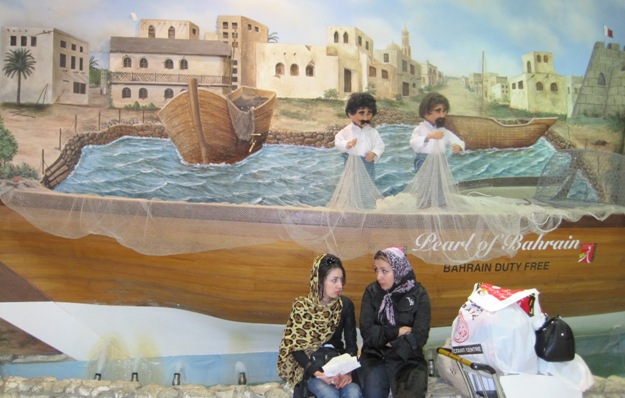
An Arabian Prison Escape with the Ethiopian Maids

     Before I get started…I was checking out the departures board in the Damascus airport and I was caught by surprise: a flight to Caracas, Venezuela on Conviasa. How about that route: South America straight to the Middle East? South America to Europe is a black hole for cheap flights; what if Caracas to “Damasco” was an option? I’m filing it in the back of my head. I may tattoo it there, too.

     I said I’d eat my passport if I saw anyone else on the Damascus-Bahrain-Addis Ababa flights, but I wasn’t thinking of 10 or 15 Ethiopian maids returning home. I’m a man of my word, though, and I needed the fiber anyway.

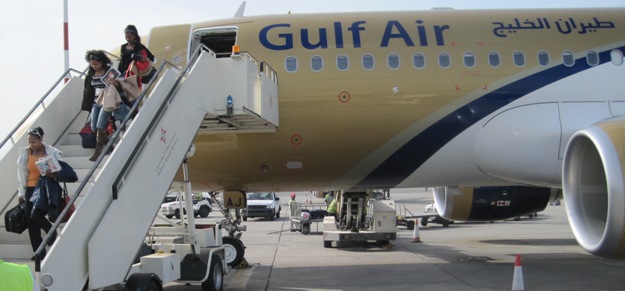
     In Bahrain I was wondering why they were boarding the plane 40 minutes before departure, but it became apparent quickly enough. Nearly the entire 737—you know, an aisle down the middle, three seats on each side—was occupied by Ethiopian maids going home with a lot of baggage. I was the only westerner and one of only a few men. It was an animated group speaking in high, chirpy voices with lots of giggling.
     The woman next to me, a clothes importer coming back from Dubai, explained everything. These girls go to the Gulf as maids, earning about $100 a month in addition to room and board on three-year contracts, and finally they were going home. She stared glassy-eyed as they were trying to cram as much as possible into the plane and stuffing it in places that was making the flight attendants work. “It makes me so sad,” she finally said, shaking her head. “You know Arabs…,” her voice trailed off.
     Oh, I know the stories about Arabs all right.
     I should make the distinction between Middle East Arabs (such as Syria, Jordan, Lebanon, and Egypt) and Gulf Arabs (Bahrain, Qatar, Kuwait, Saudi Arabia, etc.) On the surface, Gulf Arabs dress ostentatiously in their floor-length, full-body garments known as jalabiyas, often with head scarves smartly tucked under the black rope thing that I should know the name of. The essential difference, however, is that Gulf Arabs are wealthy through oil. Middle East Arabs regard Gulf Arabs as indolent buffoons who lucked into riches and subsequently became fat, lazy, and dumb. Saudis especially are the butt of hillbilly jokes.
     Gulf Arabs are also infamous for abusing their maids like slaves. There are countless sad stories ranging from the mundane (wages withheld for made-up fines or fees, passports taken away to ensure fealty) to the serious (beatings, torture, sexual abuse, and outright murder)—and those are just the stories that make the news.
     For all the jobs that poor women leave home for out of desperation, nothing is worse than being a maid in the Gulf except for being a prostitute in the Gulf. When I was in the Philippines, the global leader in exported women, I heard the stories all the time, and yet, if you are at rock bottom, what else can you do? You go to the Gulf.
     But why Ethiopians? There are only so many Filipinas in this world (they are trying hard to keep up with demand), but why not Egyptians or Sudanese, people with a more common language, culture, religion and just as poor? The cynic in me thinks it is precisely because Ethiopians ARE different.
     They are easier to exploit. They are less likely to complain—to know HOW to complain—to know their rights, so they keep their outsider status. The Ethiopian government is hardly going to complain as these women bring hard currency back home, saving them from supplying jobs. If Eskimos were as destitute, they’d be in sky-high demand in the Gulf.

     The boarding was turning chaotic. The woman next to me somehow knew who needed to be rearranged to sit with whom, which was done easily and without quarrel even though she was a stranger and we left only 30 minutes late. I told her she was like a mother to everyone and by way of explanation she stated plainly, “I didn’t receive my mother’s love.”
     After the meal (gotta love the girl who went up and down the aisle with a barf bag collecting everyone’s unused tiny packets of butter and cheese from the meal; let’s not waste food indeed!), the different moods on the plane amplified. It became more raucous with singing, clapping, shouting for friends sitting afar, and some turned angry. One girl had to be restrained from fighting another in the aisle in a feud about money, I was told. Another woman started screaming at everyone else to shut up. When it got noisy all the lights were shut off and we sat in the dark, a tactic to calm everyone down, but this group was unstoppable. It was the loudest flight I have even been on.
     If someone sang a song or yelled something, a bunch of others would yell in support, “Ayayayayayayayaya!” like kids do when they play cowboys and Indians (cowboys and Mexicans?) In a quiet lull a woman summed it all up with a primal exclamation: “The past is over!”
     It was the strangest feeling to sit in a darkened plane, hearing these cathartic bursts of emotion being released around me. I just sat there, yet was exhausted. I was relieved to finally begin our descent. Everyone felt it at the same time and roared.
     The flight attendants had abandoned ship; they stayed in their seats even though people were standing in the aisle just before we were about to land. There was a stern voice on the intercom demanding that they sit down, but who is the genius at Gulf Air who thinks it’s a good idea to have neither an Ethiopian flight attendant on board nor any announcements in their language? On the other hand, can you imagine being a regular flight attendant for this route? I wonder what the mood is like on the outgoing flight.
     As I expected, the back wheels of the plane had barely touched down when there was the loudest eruption yet, and in an instant someone leapt out of their seat and bolted for the door. I’m sure if no one had stopped her, she would have gone for the handle at 250 miles an hour.
     As we all waited in baggage claim, behind me I saw a woman who cleans the toilets in the airport leaning forlornly on a pillar, looking at the group. I couldn’t tell if any of the women on the plane had caught her eye, or how many might have wished they had that job instead of going to the Gulf.

Lastly, if the first few days are any indication, blogging in Ethiopia will be difficult. I will write stuff offline and upload it when I can. I always answer emails, but please have patience with me while I am here. Pretty please!

Hello, Ethiopia!

     I bought a one-way ticket on Gulf Air to go Damascus-Addis Ababa, Ethiopia for $281. That’s quite a change of towns. I will slather my passport in a thick layer of hummus and eat it if I see anyone taking the same two flights.
     On the website I had the option of picking what kind of in-flight meal I wanted, the first choice being “bland meal”. What do you say to the stewardess after your bland meal? “It was tasteless. Give my compliments to the chef.”
     I already made my fake onward ticket in case anyone asks for it. I am “flying” to Istanbul on Turkish Airlines in a month. Hope it passes the smell test.
     What will happen to my vast, vast readership now that I am leaving the Middle East? Will the new people stay with me? Are people interested in Ethiopia? I know very little about Ethiopia. My friend Graydon biked through there and had to continually fight off kids who tried pelting him with stones and was dismayed at the handout mentality people had. The funny thing about that is that he highly recommends Ethiopia! If I had the same experiences, I would be less enthusiastic, and my only hope that it is a place to be enjoyed rather than endured. Looking forward to it. Let’s go!

Shoes have been repaired. I'm good to go.

Goodbye, Middle East, I’m going to miss you.


     For some reason the same travelers that are staying at the cheapest hotels also like to splurge and rent cars or rent cars with drivers or get airport pickups which are all an unnecessary waste of money in Syria—or so I thought until I laid eyes on this groovy Pontiac. Can you imagine tooling around the country in this baby?
     Speaking of which, would you like another FREE tip to make some money? Start a business renting big cars like this in America to foreign travelers. Do you know how many foreigners dream of driving across the country or the old Route 66 in huge cars like this? Never mind that Route 66 doesn’t exist or that it is a much better trip to go from Seattle to San Diego along the coast. (It’s downright tragic that not enough people listen to The Dromomaniac.)
     Americans complain about high fuel prices and gas-guzzling cars are very much out of fashion, but try telling that to a Norwegian who has only seen cars like this in (American!) movies and where gas is double the price.


     Remember when I asked how the meat on the inside of a big fatty like this doesn’t go bad? A friend wrote, “I asked my Egyptian friend how shawarma doesn’t go off and he said that it’s because of the initial marinade in vinegar and spices that kills the bacteria. How well the cook knows how to do this makes or breaks the vulnerability to bacterial growth.”
     Now, you may look at this guy in the photo with some prejudice that he may be less of a master because he is smoking (and yet who doesn’t love smoked meat, even if it is menthol flavor?) but I stood and watched him from across the street as he appraised the meat, how it was attached—still a big mystery to me—it’s relation to the heat, it’s relation to the sun and the moon and the stars, and I was duly impressed. It can’t explain why I got sick later, can it?

     It is a shame that vehicles are allowed in the old city. These tiny Asian trucks blow through alleys so narrow I have to scramble to find a doorway to hide.

     When you drive out in the desert, you see trash accumulating anywhere it can.

     Construction has started on some new ruins. The old ruins were looking kind of run-down.

     Photos I forgot to take:
     1-a photo of a wide column of ants in Palmyra with the caption that ants are reviving ancient east-west trading routes.
     2-a photo of a bedouin tent in the middle of nowhere with a TV satellite dish and a caption asking if bedouins yell at their kids, “Stop messing with the dish! I’m trying to watch the game!”
     Maybe it’s all for the better.

More delectable Syrian food (with better pix!)

     I like being back at Al Haramain hostel in Damascus, great people here, but adjacent to the common area is a bathroom with a gap at the top for ventilation, meaning excellent acoustics, meaning I can hear everything going on in the bathroom. I like getting to know my fellow travelers, but not who needs more fiber in their diet and who needs to lay off the street food.

     I don't bother to ask anyone at the hostel if they want to eat with me. 'Hey, let's go get a bowl of beans for dinner!' tends to bring down a room, but this stuff is fantastic. It's 'fuul' or fava beans with chickpeas, a liberal amount of lemon juice, and an assortment of sauces. Eaten with flat bread. $1.10.


     Classic hummus. Ground chickpeas mixed with some tahine, which is ground sesame seeds, plus olive oil and other goodness. $1.10.


     The per kilo cost for the four towers of sweets that have price tags are, from left to right, 300, 500, 350, and 250. (46 pounds = $1.00.)


     I missed the infectious smile from the son of famed Abou Shaker, Damascus fruit juice maestro.


     A regular mixed fruit juice. $1.65 for this, or only $.90 without the Carmen Miranda addition.


     I might need this phone to call a doctor. I'm sick.

Al Jazeera’s coverage of Libya is must-see TV


     If anyone is interested in what is going on in the Middle East, Al Jazeera International’s TV channel has as good of a coverage as you can find, says me. I discovered them a few years ago when I wanted news during the Burma uprising, and CNN and BBC weren’t cutting it. During Egypt, too, it shone.
     Now Libya’s dictatorship is on fire, and I was watching a Saudi channel showing Muammar Gaddafi’s speech live. I had some Syrians tell me what he was saying and it was interesting enough, but I went to a fruit seller who had Al Jazeera on and they were showing a split screen with him on one side (maybe reciting poetry, as he did at one point) and the reaction to his words on the other: people hurling their shoes at a projection of Gaddafi on a wall.
     Have you ever heard Gaddafi speak? It’s almost as jarring as hearing David Beckham’s mousey voice the first time. He barks, rambles, gesticulates, he has awkward pauses, he fidgets with his clothes constantly. You can’t take your eyes off him.
     Have you ever seen Gaddafi? It’s a unique face. It looks like it has too much skin, highlighted by his flabby lips and a perfect, evil-looking, pencil-thin moustache. Plus, he’s completely off his rocker. All this together, even if I can’t understand more than three words, I’m mesmerized. I’m going to miss him.
     It would all be funny if he was crazy in a harmless, bumbling way, but I really dread what he has already reported to have done: bombed his own people. He is a scorched earth kind of dictator; I can’t imagine him in exile and thus can’t imagine it ending well.

     I came back to the hostel and the TV was on here, too. One of the travelers came to the front desk and asked the guy, “What is the situation here in Syria?” She was going to continue, but I saw the front desk guy freeze up a little and I stepped in: “You are putting him in an uncomfortable position,” I told her.
     She said, “I just wanted to ask someone who lives here—”
     I cut her off. There was a local person whom I had never seen before in the lobby, and I tried to nip it in the bud. “But there are no consequences for you.”
     Her friend said, “There could be listening devices and someone could hear us?”
     Now everyone was uncomfortable and I shooed ourselves out.
     It’s otherwise deceiving to portray myself as being wise or shrewd, but in these situations I have had experience and I know to never be the one to bring the subject up.

Last gasps of Lebanon

     It’s weird to imagine that until recently, for a long time Lebanon was under Syria’s thumb. The two are so different. Lots of travelers aren’t crazy about Lebanon because of these differences, but I’m not among them. This is the Singapore complex. The people who don’t like Singapore are the ones who just arrived from Malaysia and are disoriented that it’s a more modern, expensive, organized place with fewer rough edges. Get over it and try to appreciate it for what it is.
     But I couldn’t sleep well there and it was making me crazy, so I decided to to go back to Syria while I devise my next plan. I left a lot on the table in Lebanon. Didn’t go into the snowy mountains to ski or see the cedars, didn’t go to Tripoli, the second city, didn’t even check out the Hezbollah outdoor museum.
     I’m also going to miss that dramatic descent into Beirut from the mountain. Even if the sight of a huge city repulses you, coming from the high desert of Syria down to the Mediterranean makes you gasp the first time you see it.
     There was also an audible gasp when I saw this falafel and hummus combo laid in front of me:

Pssst! Want to make some money? Open a hostel in Beirut.

     It’s a can’t-lose idea I’m giving you for free. (The Dromomaniac gives and gives and gives.) There’s really only one place to stay now: Talal’s New Hotel, $12 a night in a dorm. (There’s another that charges the same, but it is said to be in a deplorable state.) One person put up a short, unenthusiastic review of this place on Wikitravel, but since options are limited, nothing will stop people from coming.
     To show how much contempt Talal has for travelers, they don’t even have a sign, and yet the guys here make money hand over fist. If you opened a place that charged $10 or even $12, you would be packed right from the get-go. (These days, if you provided a good wifi connection, most travelers would happily sleep in a lean-to.)
     Its proximity to downtown and the nightlife area is good, though the immediate location is across from a noisy metal shop. I’ve been here all week and I can say that if you need to get up at 7:15am, you don’t need an alarm clock. And yet, I will take the industrious noisy metal shop guy over my fellow travelers who have to hit the snooze button 15 times before they wake up. Dude, give the phone to me and I will wake you up whenever you want. Does boiling water on your forehead help?

     Yes, I did wake up on the wrong side of the bed today. How can anyone over 6 feet tall (185cm) sleep in the Middle East? The same angry dwarf has designed every single hostel bed I've been in since Jordan. Why on earth would someone put a footboard that is higher than the mattress itself? What purpose does that serve other than to thwart taller people from being able to extend their legs? There's never a mufti around to issue a fatwa when you need one.

     Doesn’t every traveler go through a phase in their 30’s with the idea of opening a hostel until it dawns on them that it is a lot more work than you realize and you have to deal with people that you’d rather not? Maybe it’s just me. If you’re feeling game, demand is growing and Beirut stands to become increasingly popular despite the very precarious political situation. The time is right. Go for it!
     The last town in which I had such a strong feeling for the need of a hostel was in Fukuoka, Japan, and next time I passed through, a new place was doing a very brisk business. Sometimes you just know.
     Why didn’t I do Couchsurfing in Beirut? It’s tough. I know other travelers who came through before me and they couldn’t even get a reply. Throughout the Middle East my experience is that it’s hard to find a host. Female travelers don’t seem to have trouble. I’ve been racking my brain to figure out why, but it will have to remain one of life’s great mysteries.

Things you wouldnt expect to see in Lebanon

     Lebanon has a lot going for it: excellent flag, sharp license plates, good-looking currency, plus a lamentably overlooked 1980s song by The Human League (The video is here. I need to start wearing eyeliner.) What else do you want? Horny Goat Weed? They have that, too!

     It's not the best picture, but look under the car and you see a baby's shoe tied around the muffler of what looks like a big Buick. What the heck?! I can't begin to think of a reason for this, but do you think Lebanese shop for baby shoes and ask, 'I'm looking for something that goes well with an '86 Skylark? Two door?'


Related Posts Plugin for WordPress, Blogger...