Hanging out with the hyenas in Harar

     I didn’t like Harar at first glance, but I arrived on a Saturday, midday, when everything is closed and everyone in a khat stupor. (More on khat soon.)
     Come Monday the old town was in its full splendor, and even though the old town isn’t as atmospheric as I expected, the people-watching is fantastic. Different ethnic groups are out here, and they are striking. Few women are in western clothes, rather they are in a colorful swirl of lightweight robes, shawls and skirts. The chaotic markets feel like they couldn’t have changed in hundreds of years.
     I met up with Chris from Liverpool (a chain smoker affiliated with the UK Cancer Institute) and last night, as you do in Harar, we went to see the hyena feeding on the edge of town. Wild hyenas, normally pretty ferocious animals, are tame enough to come and be fed strips of meat by a guy who has developed a rapport with them. I wonder about the fate of those people who failed to develop such a good working relationship with the hyenas.

     It’s a little ridiculous. The hyenas are so tame I have the feeling that next year they will be balancing balls on their heads and the guy will be working the crowd in five languages in a hyena stadium. The guy already appears to be doing very well judging by his gaudy gold chains. Still, hyenas are interesting animals and it is spellbinding to be so close to watch them.
     Enough people have been paying 50 birr ($3) for long enough now that they hooked up a light so everyone can see the show instead of hoping that a rich tourist will show up in a taxi and keep the headlights on.

     The local barefoot butcher in 32C (90F) heat. This was the first time I paid to take a photo.

Ethiopian food—the world’s most exotic?

     When I lived in San Francisco and Los Angeles, if anyone visited me I took them to eat the most exotic food I could think of: Ethiopian food. It always blew them away and why wouldn’t it? What is more exotic than Ethiopian food?
     It is heartening to see that the food is similar here and in California, except that here the injera is darker. Injera is the national staple and the basis of Ethiopian food, a thin, spongy, pancake-like, yeasty, soft, wheat-based “bread” that takes days to ferment, which makes it funny that it’s considered fast food.
     The injera is rolled out on a platter and a puree or dollops of whatever you order are laid on top and then more injera is used in lieu of utensils. Ethiopians can eat with their hands—their right hands, always—and barely make a mess, while beginning foreigners tend to have food stains up to their elbows.

     Even though I have been here over one month, I have two valid excuses about why I don’t know as much about Ethiopian food as I should. First, I arrived the day before the 55-day fast began and meat is hard to find anywhere in Orthodox Christian areas. Most people eat “fasting food” which sounds like a delicious oxymoron, but only means that they abstain from meat and dairy.

     Second, I find it hard to order anything other than the beyaynetu (above, costing usually 20-25 birr, or $1.25-$1.50) which is a little bit of everything for the same price as if you had only one item. I’m branching away from beyaynetu as it really isn’t meant to be a one-man show and I always eat alone. Ethiopians rarely eat alone.
     If two people order two different things, it will come on one platter for you to share. There is something to be said for eating communally this way. Once I stood longer than I should have and watched a couple eat together. It was lunchtime in a busy cafeteria but it was as if they were alone in a secluded bistro, sharing a tender moment as one would feed the other and the woman would “repair” the base injera by laying another piece in that spot.

     The type of wheat used to make injera is a native sand-like grain grown in high altitudes called teff. It is said to have higher nutritional value than wheat and is such a central part of Ethiopian life that there are some panicky rumors that an American group is trying to patent it. If I were Ethiopian I would be more worried that it will run the same path as Bolivian quinoa: westerners discover the health benefits of the grain, demand spikes, and locals are left with sky-high prices. I guess both have the same Doomsday scenario outcome.

     Firfir (above) literally means “torn up”. It is pieces of injera mixed with spices or meat and served with more injera, thereby doubling the load.
     In Thailand it is always said that sticky rice is great for poor peasants because it supposedly expands in your stomach, making you feel fuller than you are on less food, but I don’t feel it. After eating firfir, however, I am nearly catatonic. If I was pickpocketed right after a dinner of firfir, I would merely burp to the running thief, “It’s all yours, brother.” (Another free business idea from The Dromomaniac!)
     There is also the fantastically named fitfit, which is a wetter, less common version of firfir.

     This mixed layering of juices is called a spriss (I’ve seen it spelled endless ways). I have to keep reminding myself that avocado (the green stuff pictured) is a fruit, but I am warming up to it. Only here in the east do I come across my favorite, ambeshok (soursop) juice. This costs between 8 and 10 birr ($.50-.60)
     When you consider injera’s expanding properties, it makes sense that Ethiopians are not great snackers. There’s very little in the way of snack food here, usually peanuts and packaged junk. As far as “international food” goes, it is largely pasta, pizza and hamburgers, all of which can be pretty good.
     Wait, I just discovered the majestic bozena shiro, which is chickpeas in a thick, tomatoey, peppery sauce with tender meat cooked in a clay pot. Ethiopians are absolute masters of chickpeas and lentils.

We’re hot, we’re Muslim and we’ve got goat meat

     I picked the wrong side of the plane for the window seat. Is there a website that tells people on which side of the plane to sit for the best views? If sleepinginairports.net exists, why not whichsideoftheplane.com? Yes, it’s another—ANOTHER!—free business idea from The Dromomaniac! It’s unconscionable that I don’t have thousands of fans and remain a cult oddity.
     I didn’t feel bad that I forsook the bus (but I will feel bad if “forsook” isn’t a word; I’m using it in Scrabble next time no matter what). The landscape was parched brown and unremarkable. Could have been the middle of Nevada.

     Less-than-bustling Dire Dawa airport from the tarmac. Should we trim the trees? Nah.


     More monkeys than cars in the airport parking lot.


     Bajaj Learner! The educational aspect must be how to get on two wheels or perhaps there are seminars on overcharging foreigners.


     I know some of you are reading me just for practical info on Ethiopia you can use for a future trip and then you will abandon me the moment I leave the country. It’s OK, I understand, no hard feelings YOU WILL ROT IN HELL! (Tourette’s, sorry.) Here’s a little tidbit: the fastest internet connections are in post office internet cafes.
     I always visit the main post office anywhere I go. That’s my idea of a good time. I appreciate the old colonial buildings, I check postal rates, see what the low value stamps look like, and here, to use the internet. What I didn’t expect was that I would be singing “Moon River” for the young guy running the place, a Jehovah’s Witness who played a nonstop playlist of Frank Sinatra, Willie Nelson and Kenny Rogers, which is a novelty I can live with but I wish I could get “You picked a fine time to leave me, Lucille…” out of my head now.
     It was one of several surreal moments here. Once I sat in a bajaj when a guy on the street ran up and thrust a six month old Newsweek magazine in my hands. Thanks, I guess. How did he know I needed something to read?
     Just before this I was on the steps of a bank having a long conversation with an employee as she instructed me on the best way to get black market (illegal) dollars and the merits of doing it here vs. Harar.

     Finally, after a month of seeing goats everywhere in the country, even several times in downtown Addis Ababa crossing Bole Road, the relatively trendy main shopping street, I see goat on a menu. I had been wondering what people are doing with the goat meat and milk. The reason must be that now I am in the predominantly Muslim eastern part of the country where few people are fasting for Lent.


     Dire Dawa used to be the second biggest city in Ethiopia, but its main industry, smuggling, has fallen on hard times and the train no longer runs, leaving it a hot and dusty outpost most people blow by to see the ancient city of Harar, an hour southeast and my next destination.
     But I say to be proud of what you have. The town’s slogan should be: “Dire Dawa: we’re hot, we’re Muslim and we’ve got goat meat!”
     Why am I never hired as a tourism consultant? This world is so unjust.

     There are few cars on the road, again because of the high taxes to import them. The raven-haired Italian girl of the last post informed me that there is a 250% tax on imported cars based on the government estimate of its value. I believe anything she tells me.


     I’m staying a day longer than I normally would here in Dire Dawa because I found a mellow place called African Village (above) run by a mellow Swiss guy. It’s clean, quiet, has excellent food, and is 130 birr ($8) a night.

     I can put my finger on an example of why I like Africa. Parked in front of the post office was a bus where a few guys were loading big bags of mail on the roof to be delivered to Addis Ababa. It seems very African to do that in front, on the street, and not hidden away somewhere in the back. So much goes on in the street, in view of everyone, which gives it a vibrancy. People chew chat out in the open, too, instead of going behind closed doors. More about chat later.
     Do you wonder why I don’t have many people pictures in this blog? In my experience Ethiopians usually recoil when I ask if I can take a photo, aside from these kids in the market.

     This defies explanation. How can you have a giant screen TV showing international soccer highlights in a town where maybe 1 out of 30 street lights work? The contrast between the dilapidated, closed train station and the big screen TV---the only modern thing in the entire town---couldn't be sharper.

On the road again without Anne Hathaway

     I learned that I missed Anne Hathaway by about a week in Bahir Dar. My Couchsurfing friend in Addis Ababa helped put together her itinerary in Ethiopia. Who would have guessed that after hosting the Oscars, Anne Hathaway zooms off to Ethiopia? She brought her boyfriend, which is for the better since I didn’t want it to be awkward if we met. She was a little clingy, what do you want from me?
     It’s convenient that lots of people speak English in Ethiopia as my Amharic isn’t quite at a fluent level just yet. Have you ever seen Ethiopian writing?

     I can't help it. Every time I see the Ethiopian alphabet, I think of the wingdings font.


     Sickness has more or less passed (cough!) and I’m flying today to eastern Ethiopia, to its second city, Dire Dawa. I must admit that I feel a little guilty about spending the money to fly. It was 670 birr ($39), The alternative is an estimated 11 hour bus that leaves at 5am which would cost about 300 birr ($18) including the taxi to get to the bus station at that ridiculous hour. I am most troubled by it because the last third of the trip is supposed to be especially beautiful landscape. I rationalize it partly by reminding myself that if I can’t get out of Somaliland to a place I want to go, I will have to return via this route. Or am I just getting soft?

     Felt a little better about my decision not to take the bus when I made a day trip 40km south to the crater lakes of Debre Zeyit. (Lake Bishoftu is pictured above.) The road is chaotic. Even if the Dire Dawa bus leaves at 5am and avoids the traffic getting out of town, there are villages strung along the entire route, I surmise. It’s also worth a few birr not to have to watch 10 hours of Ethiopian pop music videos on board the bus. The first half hour is fascinating, the first hour is interesting, and by the second hour I am ready to pry my eyeballs out with a butter knife.

     Enjoyed some reverse hitchhiking in Debre Zeyit where a group in a car pulled up next to me as I was going up a hill and asked if I wanted a ride. They happened to be going back to Addis. It’s a great luxury to be driven in a car in Ethiopia. They left me near the airport in Addis, about 2km away from my hotel. In the great tradition of legendary Ethiopian runners Abebe Bikila and Haile Gebreselassie, I took a minibus.
     Haile Gebreselassie is still very much alive and there is a main street in Addis named after him. Since he is a living legend, maybe he felt emboldened enough to endorse a whiskey brand. I can’t look at the billboards around town without wincing.

     Met a beautiful Italian girl (giant hair, long name, strong accent—the whole deal) in the post office yesterday. She was so pretty that I wasn’t even phased that she was mailing a postcard to her cat. We checked out a couple of museums and then she flew home.
     Sorry it isn’t a better story.

Still thinking of going to help in Japan

     What about the most northern part where there was damage? Aomori-ken? Isn’t it away from prevailing radiation winds? What if I brought a tent and a sleeping bag, maybe a little camping stove, a few jugs of water, and box yakisoba or ramen? (I’m having flashbacks to sophomore year in college.) What demands would I be making on local supplies other than an occasional shower or using the toilet?

     Hitchhiking through the area in better days

     I haven’t thought it all through about how I can be useful, but I like the thought of clearing debris from foundations and hauling it away so they can make a fresh start. I might have to borrow a small truck from my friend Greg and then I might hit up everyone for small donations for gas and incidentals like this.
     Japanese bureaucracy would have to cut me some slack. I doubt tourists can drive cars long without insurance and I have seen firsthand several times how asinine city dumps are about what they accept and what they charge.
     There was an argument on the Couchsurfing Tokyo or Japan group about the wisdom of going up to try and help if you aren’t fluent in Japanese, but I don’t buy that. If I was a nurse, OK, but is miscommunication when doing manual labor so fraught with peril?
     Japanese aren’t big on asking for help. Once I visited Greg and during a big storm the tiny river next to his place burst its banks. Water was rising at a nearby elderly couple’s house so we went over to make sure it didn’t get high enough to enter and destroy their tatami (woven reed floor) mats. I don’t remember what we did to divert it, but they would have suffered in silence if we hadn’t been proactive and saved the day, as little a gesture as it was. Japan is full of old proud people who could use a hand.
     I haven’t followed the news very much. It makes me berserk when I see TV reports about the economic cost of the disaster. How can anyone care about that? It seems the government doesn’t know or is negligent about how much radiation is getting out. Imagine being a worker trying to stem the radiation leak at that nuclear facility? That’s bravery. I would have abandoned ship and raced as far away as possible.

     I started the ball rolling by posting this on Lonely Planet’s Thorn Tree and Couchsurfing’s Japan group. I quote myself liberally, a sure sign of megalomania, but already opinions are flowing in. What do you think?

The economics of being sick while traveling

     How is that for a high-falutin’ title? I just want to mess with the people who are doing serious research and find me on the 4532nd page of Google.
     Wait a second before I get started. Let me empty my ashtray full of phlegm. (Photos upon request.)
     The economics of being sick are merely that I spend more money than when healthy. I take flights, I stay in nicer places, eat better (more expensive) food, and so on. Obvious stuff, really. I wish I could rest at a CouchSurfing host’s, but I don’t want to make anyone sick and I am hardly a good candidate in my condition: “Hi, my name is Kent and I have been a wheezing bag of germs for over two weeks now. Can I visit?”

     I am staying at a hotel called Mr. Martin’s Cozy Place. I like it here because it is indeed cozy, there is hot water and water pressure at the same time, and everyone is used to my coughing fits. These are qualities you can’t sneeze at. Most Ethiopian hotels are a paradise for Peeping Toms with windows above the doors, but not Cozy. Most hotels have 3-watt light bulbs that you can’t read under. Not Cozy. A hot water shower is rare, and hot water combined with water pressure doubly so. Viva Cozy!
     For two nights Cozy was full and I had to stay nearby at the Rose Pension, also named the Roth Pension, which is a brothel. How do I know it is a brothel? Maybe the packet of condoms on the towel? Then there’s the woman who showed me the room and said it cost 120 birr ($7) and was excited to announce, “You can stay 24 hours!”
     Ethiopia’s currency is the “birr”, pronounced “brrrr” with the rolled “r”. I say all frozen food should be priced in birr. Or if a temperature is less than zero, instead of degrees, we should say it is “minus five birr.” One US dollar is about 16.6 birr.
     Paying 173 birr to be cozy is a little excessive, more than what I am used to, but if it facilitates my convalesence, this is when you need to reach deeper into the pockets. Most low-end hotels cost between 70-100 birr, but if you pay a little more, say 150-250 birr, the quality goes way up.
     You may be asking yourself, why not always pay the extra $5-$10 a day and live better? On a long trip the difference really adds up. Besides, it isn’t really $5-$10, but 80-160 birr, or more to the point, the amount of goods and services you would get for 80-160 birr. You can get quite a lot for that. I had lunch yesterday at the main post office cafeteria for 12 birr. To mail a postcard is 4 birr. A minibus ride across town is about 3 birr. A two-liter bottle of water is 8 birr. A croissant the same. A pizza about 40 birr. Internet is usually about 15 birr an hour. You get the idea.      Traveling cheaply doesn’t have to be a mad race to the bottom, but you become accustomed to making that your comfort level.

     You might also be asking why I am not resting somewhere—anywhere— other than in the big city. I like big cities. They tend to have electricity, running water, greater food choices, access to pharmacies and doctors, faster internet and goodies like this. Cough syrup was 110 birr in Lalibela and is less than 30 birr here in Addis Ababa.
     My coughing and phlegm have gone way down since I started taking ibuprofen with the Cipro. I can see even light at the end of the tunnel.
     Can’t decide where to go next. I could visit Jimma. A tourist brochure really knows how to sell it:

     “Near to Jimma there is a hippo pool where the hippos are reputed to be exceptionally large. Regrettably, irrigation schemes threaten to dry up the pool and the hippos will gradually die out in this area.”

     Come on down!

A combative visit to the Somaliland embassy in Addis Ababa, Ethiopia


     I like embassies. I’m not crazy about running around town trying to find embassies or paying for visas, but it’s an interesting introduction that is usually representative of traveling in the country. There is a North Korean embassy I might visit if I was feeling better. Why would there be a North Korean embassy here? Any ideas?
     Normally I really need a visa and want to make sure everything goes right at an embassy, but in this case, if the Somalilanders refused me, I wasn’t going to be devastated. I even thought of putting “shifta” (bandit) on the application for my occupation, but decided against it. So when I paid $50 for my $40 visa fee and they asked if they could pay me in Ethiopian birr for the difference, I wanted to know at what rate. They wanted to shortchange me 5 birr (about US 30 cents). I was non-committal about it, saying I might pick up those 5 birr when I returned for my visa in the afternoon.
     In possible retaliation the girl slyly dug out my visa application again and asked, “How old is this photo?”
     Ouch! That hurt. She was good. That photo was at least 10 years old. I am always trying to fob off ancient visa photos. I tried not to appear unnerved. “One or two years, maybe.”
     She looked back at the photo and then at me again with skepticism, so I went on the offensive. I coughed and said with my gravelly voice, “I’m sick. I only look 100 years old now because I am so sick. I feel 200 years old and look 100 years old. And I forgot to shave.” I coughed some more and she was mollified enough to overlook this obvious transgression or she was simply eager to have this bag of germs leave.
     When I went back in the afternoon to pick up the visa and said, “Habibi, how about those 5 birr?”, her eyes got big at my chutzpah. I protested, “That’s two and a half injera!” Injera is the national staple food, and economic comparisons to the cost of it always and instantly make sense to Ethiopians, even if they are always and instantly amused at a white guy making the case for it. She had the other woman in the office scrounge around for 5 birr, and when they could only come up with 4.95, I said that it would be OK this time, but I was going to keep my eye on them.
     They knew I was talking nonsense but were ready to throw me out of the embassy compound anyway.

     The Somaliland visa stamp. You're telling me you couldn't forge this? They botched my name, but I won't hold it against them.


Two things I learned about Somaliland that give me pause for thought:
     1–My visa starts today, even if I don’t intend to go there so soon. No matter when I go, I have to be out in a month from now.
     2–Somaliland is an all-cash place: no ATMs, credit cards, travelers checks, etc. I might fly out of there, so I will need a lot of cash to buy a ticket. You would think I would therefore be a juicy target for shiftas.
     Quick story: This was the same situation in Vietnam back in the early 1990s. One day our group passed a cement truck that had been robbed and everyone killed right in the middle of the road. The thieves targeted it because they knew they had just made a delivery and had cash. They got away with about $200. I had $800 in cash on me. Everyone in our van was similarly loaded.
     Then, as now, there is no American embassy.

     Semi-unrelated to anything: This link shows a map of what percentage of people in each state in America have passports. New Jersey has the most per capita and Mississippi has the least. I thought for sure California would have the most.

     On the advice of my Italian doctor (I like saying that), I am taking antibiotics, Cipro, to be exact, but three of the past four nights have been hellacious as I try to sleep while in a coughing frenzy. I simply cannot stop coughing. Drinking tea or taking pills provides only temporary relief. It’s horrible, in case you weren’t sure.
     I could have relied on the medical advice of the local pharmacist, but I was distracted by her shirt being unbuttoned halfway to her belly button. There are several kinds and prices of the same drug based on where it was manufactured. Do I want it from Switzerland, Cyprus, Kuwait, or India? I went with the Swiss at 75 cents a pill.
     If only I could find a buyer for all my phlegm. I would be rich!

The shifta is still sick

     It’s not fun being sick while alone, while alone in another country, while alone in a village with no pharmacy, no electricity for a day and a half, and no healthy food options. I have to say, I have a huge latent appreciation for electricity. Big fan.
     Been sick a solid eight days. Now it’s all about my coughing and hacking phlegm by the liter, plus my voice is like Darth Vader’s.
     There’s no pharmacy here in Lalibela but there is a clinic over the hill where I did get some cough syrup, but the bottle is empty by now and I’m no better.
     It is seriously incredible how much phlegm is in my system. Every night I sleep with a plastic bag or some papers on the floor next to the bed so I can lean over and spit out phlegm in the dark and hopefully hit the target. I can summon up a gooey, greenish glob at will just like others can belch at the drop of a hat. How did I get so much? Is there a Guinness world record for Most Phlegm, middleweight division? (I’m getting closer to middleweight. I’ve lost about 10 pounds (4.5kgs) already on this trip. It would be something to celebrate if I didn’t balloon up to morbidly obese before I left home.)
     I saw a doctor—two doctors—sort of. I met two Swedish medical students who had a look at me. In lieu of a tongue depressor we used my ballpoint pen. Their diagnosis was a virus that I just have to rest and get through. Then I met some Austrian nurses who gave me some pills.

     Look at this artsy photo of the girl next to me on the plane. I'm a scary talent.


     Gonder to Lalibela is a 12 hour journey east on two buses with a 5am start and two hours on a dirt road to finish—or a $28.50 domestic flight. Young Kent Foster might have scoffed at not doing every segment overland, but for Decomposing Kent Foster, it’s a no-brainer—and you can bet I am going to try and accrue frequent flier miles, no matter how few there are.
     When I first got to Lalibela a few kids hanging out near where I stay asked me my name and I said, “Abebe Bikila”, a famous Ethiopian marathon runner from the 1960s. Somehow word got around and whenever I step out of my hotel and on to the street, there are always shrieks of “Abebe Bikila! Abebe Bikila!” It was fun in the beginning when I was buzzed to be here, but now I have no energy to respond when I huff and puff up the street like a decrepit 80 year old man.
     Other times I hear people call out to me, “Shifta!” That’s another thing I regret saying in my failing health. If I register in a hotel and the form asks for my occupation or if someone asks me my job, I say, “shifta”, which always gets a laugh. It means “bandit” and is the only local word I knew before I came here since I often read of problems with shiftas near Ethiopia’s southern borders.
     In Hindi the word for bandit is “dacoit”. Just showing off.

     This is the restaurant at the Lalibela Hotel, the cheapest place in town but the coolest restaurant


     To match my Simiens debacle, I thought of going the whole perverse nine yards by staying in Lalibela for four nights and not seeing the churches which are arguably Ethiopia’s number one tourist attraction, but I summoned up the requisite energy and did it. I’m not afraid of this conversation either:
     “What did you do in Lalibela for four days if you didn’t see the churches?!”
     “Oh, I had a Filipino movie on my laptop I had been wanting to see. Stuff like that.”

     Lalibela is know for its 11 churches carved out of rock, and not into the rock, but carved entirely away from the surrounding rock. It’s an incredible thing to imagine how that was managed so many hundreds of years ago. I grumbled about the 350 birr entrance fee for the area ($21), but when I saw Bet Gyorgyis below, I was awestruck:


     I flew from Lalibela to Addis Ababa today. The choice in this case was a two-day bus ride or a $53 flight. By “two-day bus” I mean two separate days, not overnight. There is no night transport in Ethiopia. Is it because of the shiftas? Again, in my health, I only agonized about this decision for a few minutes.
     I’m thinking of getting a Somaliland visa tomorrow. From what I hear, it sounds like paradise, even if I do need a police escort anywhere I travel. Shiftas, you know.

The earthquake in Japan

     Now that I am back in Gonder I’m learning about the earthquake in Japan. It takes forever to open links on slow internet connections here, so I only glimpse at headlines for now. I’ve traveled in that area twice. A funny story is here. I’ve heard Japanese say that the region, Tohoku, is the “real” Japan. Sometimes I think they mean it as a backhanded compliment, that it never changes, and there’s a brain drain of young people to Tokyo, but I’m sure everyone is anxiously glued to the news. I met a Japanese couple today from Tokyo that looked a little shell-shocked.
     My impulse is to go over and help (if there’s no radiation), but after a catastrophe, do they just rebuild? What can I do? Any suggestions?

How not to visit the famous Simien Mountains of Ethiopia

     I’ve had a rough four or five days. I went all the way to the edge of the sublime Simien Mountains, one of the top sights in all of Africa—and never saw them.
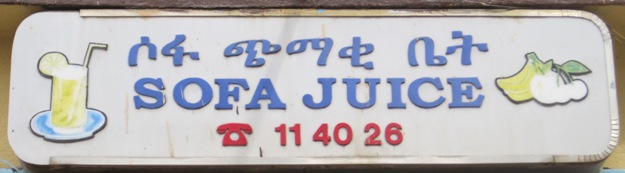
     You know, someone is going to see this and realize that Sofa Juice would make a great name for their indie rock band and when Sofa Juice is headlining a world tour will I get any thanks? No. Life sucks.


Chronologically:
     At my hotel in Bahir Dar I thought I was just being my normal cheery, chatty self with the ever-smiling receptionist—until her little brother started calling me “Uncle”. I changed hotels the next morning. Besides, I can’t get involved with a girl who handles filthy Ethiopian banknotes all day. Don’t get me started on the prevalence of yeast infections among bank tellers. As Ron Burgundy would say, “It’s science.”
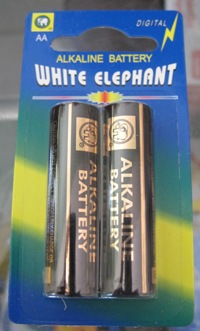
     Made in China. Their English always makes me feel better.


     To leave Bahir Dar I went to the bus station (a dirt lot) where I was besieged by touts. A tout is someone who is trying to get you to buy a service or product. In the travelers case it’s a hotel, bus, restaurant, tour or guide service. These touts hang outside the gates demanding to know your destination so they can lead you to a particular bus where they will get the highest commission when they overcharge you. I know this, and yet I was ready to throttle one guy who followed me around like a jilted lover with nothing better to do than make sure I didn’t pay the local price with anyone else.
     The other reason bus touts hound people is simply to fill the bus up so they can go. I can’t see the logic of buses not leaving until they’re full, because I always see people on the edge of town or out in the sticks trying to get on with no luck.
     Gonder is about 200km north of Bahir Dar. It’s OK, but lacks Bahir Dar’s ideal lakeside setting. When I got to town I was again a magnet for guys trying to “help” me. I verbally lashed out at them, but I thought about it and took a different tack because I don’t want it to be my main memory of a place. Instead I simply stopped to talk and joke with them and now I am on good terms with all of Gonder’s touts. I may have gone too far the other way as now at least half a dozen guys—kids, really—yell, “America!” when they see me, and they always see me.
     I asked one of them, “Why aren’t you in school?” and the kid says in disbelief at the stupid question, “I’m hustling!” as if anything else could be as important.
     If I was (were?) Ethiopian, I would be a tout. Making money from tourists has to be the easiest way to survive.
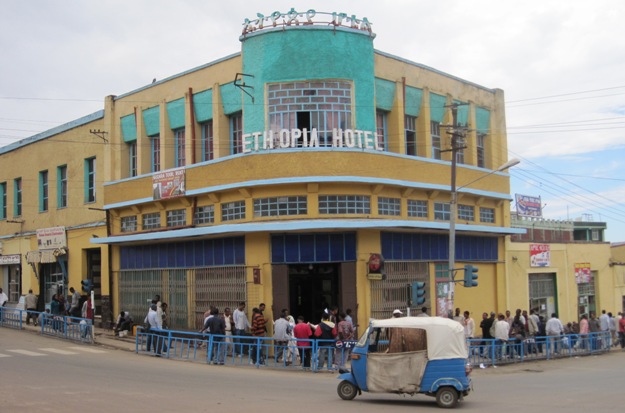
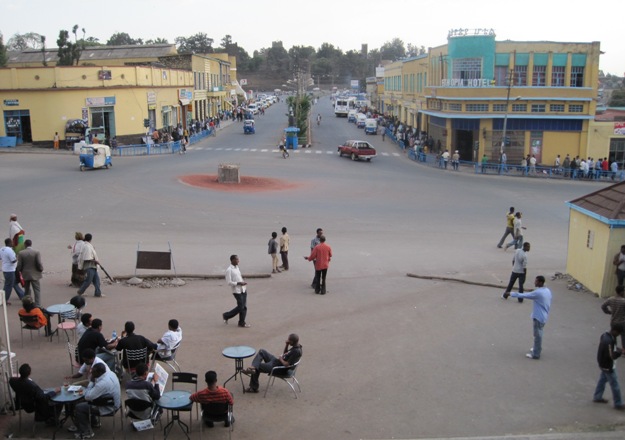
     A view of the 'piassa' from the Gonder post office


     I come this way to head to the town of Debark, 100km north, for the trip into the Simien Mountains. To prepare I loaded up at the only ATM in town that accepts international cards and bought dry goods like tuna and nuts that was said to be more expensive or nonexistent in Debark (How can a town of 40,000 not have much in the way of food? I soon found out.)
     I knew this stretch of road would be slow as it’s part of the last section of the Northern Route loop that has yet to be paved, but I didn’t expect more than five hours to go 100km (62 miles?). More than five hours! How long can you handle bus rides that take more than five hours to go 100km How many times can you do that? How many? It was brutal. I was ready to hang myself. Typical was the long delay before we even got out of town. It was explained to me as a “technical problem” that turned out to be the bus driver forgetting his driver’s license.
     By the time we arrived I was a doddering, quivering fool covered from head to toe in a thick film of dusty grit. And then I discovered that Debark only rarely has electricity and even rarer is water. Lovely.
     I am aware that my complaining is falling on very deaf ears among my fellow travelers, especially the ones before me who have glossed over the last few sentences because they are saying to themselves, “Wait, did he say there are ATM machines in Ethiopia now?” and “Did I just read correctly that there are parts of the Northern Route that are paved now? What is this idiot whingeing about again?”

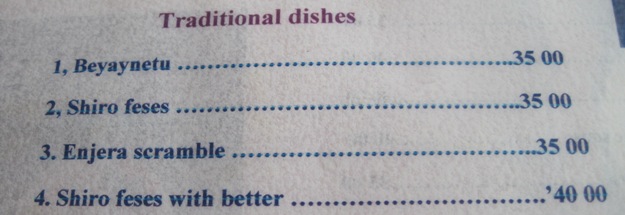
     At the unique land Scape hotel I’m open-minded enough to try roasted lamp, but not shiro feses:
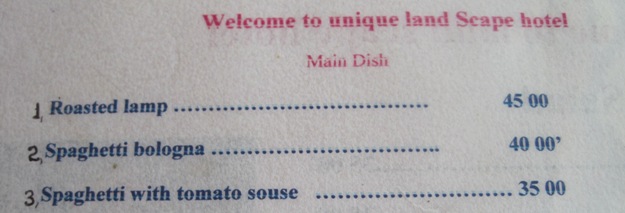

     Whatever. It’s good preparation for hiking in the mountains. I went down to park headquarters and got all the info I needed, and then woke up sick the next morning and haven’t been healthy since. It feels like a flu of some sort. I don’t know what it is or how to get better. I get dizzy walking up stairs, like my brain is about to hemorrhage. I never know what medicine to take. In my toiletry bag I have an impressive collection of pharmaceuticals from around the world: Thai ibuprofen (I think it is ibuprofen), Japanese pain killers, French hay fever pills, German valerian root, and some homeopathic stuff my friend Lisa gave me. I left the Philippine antibiotics at home this time.
     I thought of waiting for my condition to improve in Debark, but I couldn’t envision getting better there. Food was limited, just spaghetti and local food. Normally I have a very impressive capability to eat the same food for days and days on end, and for the last two weeks I have had nothing but local food save once or twice, but I wanted something else and Debark didn’t have anything. Debark supposedly has 40,000 inhabitants, but it’s really a one-road town that has tons of people living in far-off settlements.
     For two long days I stayed in Debark, a sloshy mud pit of a town when the afternoon rains come. The third day I thought I might be OK to make at least a day trip into the park if I could latch on to another group heading in, but I was gassed walking to the park headquarters on the edge of town and the group never materialized.
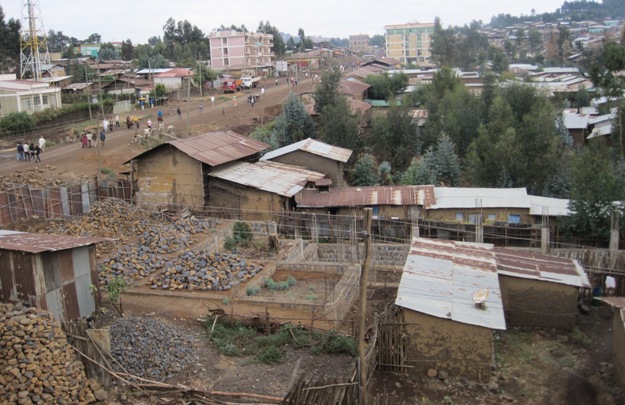
     The view of Debark from my hotel. It looks better the farther away you are. At the lower right note the satellite dish on top of the mud hut with the corrugated metal roof. Ethiopian TV will cut off local programming to broadcast Champions League soccer games live, so it makes sense, right?


     My plan was to keep heading north to Axum, 200km away, but it’s the same dirt road in worse shape and if you don’t want to risk trying to get a seat on the only bus that originates in Gonder, you have to pay someone to sit on the bus for those hours and then take their seat. (That’s a hell of a way for a local to make money. I wonder what that job title is called.)
     I decided to head back to Gonder on what became an equally horrendous journey. I had arguably the best seat on the bus, the front seat, but it was still miserable and my legs were cramped. This time it rained and I thought it would keep the dust down, but it meant that we slipped and slid going up and down hills. I’m sick of the same old music on my mp3 player and sick of traveling alone on these wretched bus rides. I tried to focus on the scenic countryside. I see things I don’t often see elsewhere, such as twice I saw a procession carrying a cadaver over their heads on a woven rack, an umbrella shading the head.
     I see people in the countryside run to the street to try and get the bus to stop, which rarely happens unless the bus driver knows them. A missed bus isn’t the end of the world, but it’s disheartening to see their faces when they get passed. Rural people get the shaft every time.

     It looks like the Chinese are the ones paving the road. You have to give them credit, even if it is purely a business decision in exchange for a natural resource. Who else was going to step in and do it? The Chinese have been clumsy and heavy-handed in dealing with local workers in such projects across Africa, but they will learn.
     You know the next step? Allowing the little Asian-made white utility trucks into the country duty free. There are 82 million people in this country, the second most populous in Africa after Nigeria, and very, very few private cars. What reason could there be other than high tariffs to import them? To protect what local industry? Public transport? There’s not enough of a supply of buses in the country and the city, anyway, which are all Japanese already. What am I missing? Must be political. Whomever the transport minister is should be forced to ride the Gonder-Debark bus back and forth until his head is screwed on right.
     My friend Greg in Japan, a guy who sees how cheap used cars go for firsthand, and I talk about this all the time. These simple, low-emission tiny trucks cost almost nothing to buy and ship, and it would profoundly change the lives of anyone who had one. What is the argument against it? We shouldn’t be burning even more fossil fuels? Suddenly we are drawing the line at stunting Ethiopia’s growth? It’s patronizing to say Ethiopians shouldn’t have the same opportunities as everyone else in the wasteful first world.
     I don’t think Ethiopians are too poor to buy them. They can pool their money together so everyone has a stake in its use and care. Besides, it would be entertaining to watch someone actually pay for one; the largest banknote in Ethiopia is 100 birr, which is a little less than $7.
     Think how efficient you could then be and how much time would be freed up to do something else (like starting a mobile cart, cut fruit business a la Thailand. Ethiopians love fruit juices. It’s a natural extension that they would pay for cut fruit. Just another free business idea from The Selfless Dromomaniac.)
     These bus rides are so slow I analyze transport economics for hours.
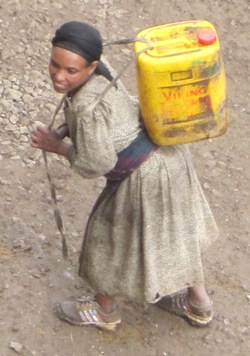
     Last week I read in an Ethiopian newspaper about the government crowing that more and more Ethiopians have access to water these days. “Access to water” was defined as being within 500 meters of where you live. Is the bar really so low? Even so, I’ve passed through villages where women sit glumly next to their yellow plastic five-gallon jugs as they wait in long lines for water and countless times have I seen women hunched over with these heavy tanks on their backs.
     Debark has 40,000 people, many very near water taps, but in my three nights there was no water and only electricity for a few hours, so how should we measure progress?
     Women are always the ones with the heavy loads. I see men sitting around all day long while the women work. I could be wrong, but I think I see more barefoot children carrying stuff to and fro than I do men. I don’t get it.
     I forgot the wise words that a traveler told me the other day, something to the effect of, “If there is hot water or anything else that is in irregular supply, don’t assume it is there later. Use/get it right away.”
     This dovetails nicely with my friend Caleb’s point about the biggest difference with being in Europe vs. Africa. When you turn on the tap in Europe, there is no question about the result, and that certainty— I forget the rest. Did I mention I am sick? Check out his website.
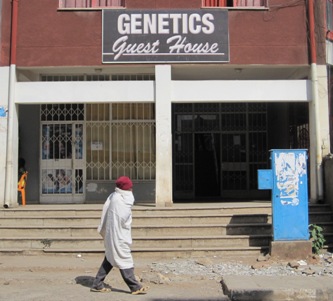
     I keep thinking to change hotels, but I'm apprehensive about the check-in procedure (and do Aryans pay half price?) By the way, in 16 days in Ethiopia, I have slept in 11 different beds. I don't sleep well.

     (Lots of gratuitous friend references in this post just to remind myself that I have friends. Being sick and alone in Debark, so close to magnificent scenery that I never saw, is tough on the psyche.)
     Well, I checked into the Belegez Hotel, making sure they had hot water (people working in hotels tend to tell me what I want to hear), and had to go eat something healthy and run errands. So when I came back tonight and the water was only a trickle—after four days of wearing and sleeping in the same filthy clothes—I yelled at the shower head, “No! NOOOOOO! You can’t do this to me!” as if in the preliminary stage of a nervous breakdown until it occurred to me that everyone in the courtyard can hear my ranting.
     I might just hunker down in my room and check out late tomorrow.

Related Posts Plugin for WordPress, Blogger...